Author: Umar Farooq
Date: August 15, 2026
Category: Mathematics & Conversions
Read Time: 6-7 minutes
Expert Review: Mathematics & Measurement Specialist
How Do You Convert Units Using Proportions?
Unit conversion using proportions works by setting up a ratio between known measurements. When converting from one unit to another, you create a proportion equation using the conversion factor. For example, to convert 5 kilometers to miles, you’d use: 1 km / 0.621 mi = 5 km / x mi. Solving this proportion gives the answer instantly. Our free proportion calculator for units automates this process.
What Is Unit Conversion Using Proportions?
Unit conversion using proportions is a mathematical method for changing measurements from one unit system to another. Whether you’re converting kilometers to miles, pounds to kilograms, or Celsius to Fahrenheit, proportions provide the framework for accurate conversions.
The beauty of using proportions for unit conversion is that you don’t need to memorize formulas. You set up a proportion ratio and solve. This approach works universally across all measurement systems. A proportion calculator for unit conversions makes the math automatic while you focus on the concepts.
How Proportions Work for Unit Conversion
Every unit conversion is fundamentally a proportion problem. When you know the conversion factor between two units, you create a proportion equation.
Basic Structure: Known Unit / Known Conversion = Unknown Unit / X
Example: Convert 10 inches to centimeters (1 inch = 2.54 cm)
- Proportion: 1 in / 2.54 cm = 10 in / x cm
- Solving: x = 25.4 cm
Understanding how to solve proportions directly helps with unit conversions. Every conversion uses the same mathematical principle—cross multiplication applied to measurement relationships.
Common Unit Conversion Formulas Using Proportions
| Type | Conversion | Formula Using Proportions |
|---|---|---|
| Distance | Miles to Kilometers | 1 mi / 1.609 km = x mi / y km |
| Weight | Pounds to Kilograms | 1 lb / 0.454 kg = x lb / y kg |
| Temperature | Celsius to Fahrenheit | C / (5/9) = (F – 32) / 1 |
| Volume | Liters to Gallons | 1 L / 0.264 gal = x L / y gal |
| Length | Inches to Centimeters | 1 in / 2.54 cm = x in / y cm |
A proportion calculator for unit conversions handles all these formulas. The beauty is that all conversions follow the same logical structure—once you understand one, you understand them all.
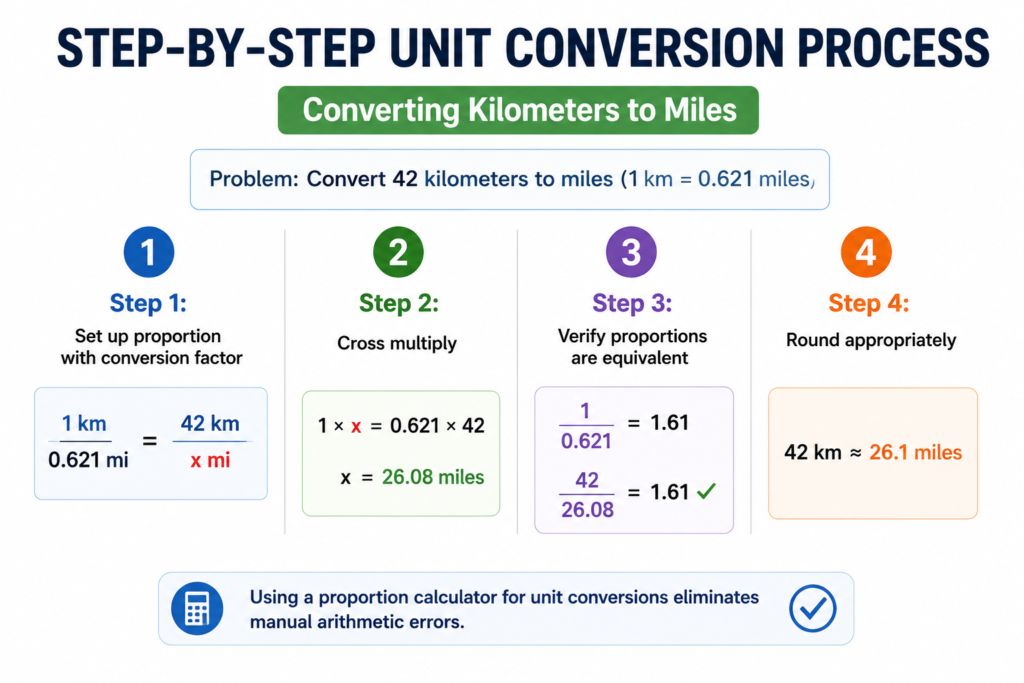
Step-by-Step Unit Conversion Process
Converting Kilometers to Miles
Problem: Convert 42 kilometers to miles (1 km = 0.621 miles)
Step 1: Set up proportion with conversion factor
- 1 km / 0.621 mi = 42 km / x mi
Step 2: Cross multiply
- 1 × x = 0.621 × 42
- x = 26.08 miles
Step 3: Verify proportions are equivalent
- 1 / 0.621 = 1.61 and 42 / 26.08 = 1.61 ✓
Step 4: Round appropriately
- 42 km ≈ 26.1 miles
Using a proportion calculator for unit conversions eliminates manual arithmetic errors.
Metric to Imperial Conversions
Converting between metric and imperial systems uses the same proportion methodology. Here’s a comprehensive reference:
| Convert From | To | Factor | Example Proportion |
|---|---|---|---|
| Kilometers | Miles | ÷ 1.609 | 10 km = ? miles |
| Kilograms | Pounds | × 2.205 | 50 kg = ? pounds |
| Meters | Feet | × 3.281 | 100 m = ? feet |
| Liters | Gallons | ÷ 3.785 | 50 L = ? gallons |
| Celsius | Fahrenheit | C × 9/5 + 32 | 25°C = ? °F |
Each conversion works identically when using proportions. Set up the ratio, cross multiply, solve. A proportion calculator for unit conversions makes this instant and error-free.
Real-World Unit Conversion Applications
Travel Planning
Converting distances between countries. If a road sign shows 100 km and you think in miles use our calculator: 1 km / 0.621 mi = 100 km / x mi → x ≈ 160.9 miles.
Cooking & Baking
Converting recipe measurements across regions. When a recipe calls for 250 grams but your scale measures ounces, proportions solve it: 1 oz / 28.35 g = x oz / 250 g → x ≈ 8.8 oz.
Medicine & Healthcare
Dosage conversions require precise unit conversion. Medical professionals use proportions to ensure accurate medication amounts when units differ between regions.
Scientific Research
Laboratory experiments often require unit conversion between measurement systems. Scientists use proportions to maintain precision across different regional standards.
Common Unit Conversion Mistakes
| Mistake | Problem | Solution |
|---|---|---|
| Inverted ratio | Using wrong factor orientation | Check which unit multiplies vs divides |
| Decimal errors | Misplacing decimal point | Write conversion factor clearly first |
| Forgetting to convert back | Leaving answer in wrong units | Label every step with units |
| Rounding too early | Accumulating errors | Round only the final answer |
| Using wrong factor | Using incorrect conversion value | Verify conversion factor source |
A proportion calculator for unit conversions prevents these mistakes automatically by handling all arithmetic.
Frequently Asked Questions
Q: Can I use proportions for all unit conversions? A: Yes. Any measurement conversion can be solved with proportions. Our proportion calculator works for all units.
Q: Why use proportions instead of direct formulas? A: Proportions teach the underlying mathematical principle, making conversions intuitive.Learn the difference between ratios and proportions to understand this better.
Q: How do I convert temperature with proportions? A: Temperature uses a different proportion structure because Fahrenheit doesn’t start at zero. Use: (C × 9/5) + 32 = F. For learning more, see our complete proportion guide.
Q: Can proportions handle complex conversions? A: Yes. Multi-step conversions work by applying proportions sequentially. Convert A→B, then B→C to reach your final unit.
Q: Is manual calculation or calculator better for learning? A: Practice manually first to understand, then use a proportion calculator for unit conversions to verify and speed up work.
Conclusion
Unit conversion using proportions reveals the mathematical elegance underlying measurement systems. Whether converting kilometers to miles, pounds to kilograms, or liters to gallons, proportions provide a unified framework. Master how to solve proportions, and unit conversions become straightforward.
For practical applications, use our free proportion calculator to verify conversions. For deeper understanding, explore our complete guide covering all proportion concepts and real-world applications.