Author: Umar Farooq
Date: August 15, 2026
Category: Mathematics & Proportions
Read Time: 6-7 minutes
Expert Review: Advanced Mathematics Specialist
Quick Answer: What’s the Difference Between Direct and Inverse Proportion?
Direct proportion occurs when two quantities increase together—if one doubles, so does the other. Inverse proportion happens when quantities move opposite—if one increases, the other decreases. A direct proportion calculator solves the first type; an inverse proportion calculator handles the second. Understanding both types makes proportion solving powerful across all applications. Explore our complete proportion calculator supporting both methods.
What Is Direct Proportion?
Direct proportion is a mathematical relationship where two quantities increase or decrease together at a constant rate. When quantities are directly proportional, they maintain a consistent ratio. If you double one value, the other doubles automatically. This relationship is fundamental to countless real-world scenarios.
Direct Proportion Formula: Y = k × X (where k is the constant of proportionality)
When you understand how to solve proportions, direct proportion becomes intuitive. Every time you use a proportion calculator for everyday calculations—cooking recipes, distance calculations, percentage problems—you’re using direct proportion principles.
What Is Inverse Proportion?
Inverse proportion describes relationships where quantities move in opposite directions. When one value increases, the other decreases proportionally. Mathematically, if one variable doubles, the inverse-proportional variable is cut in half.
Inverse Proportion Formula: Y = k / X (where k is the constant of proportionality)
Inverse proportions appear everywhere: more workers complete a job faster; higher pressure reduces gas volume; increased speed means less travel time. Learning to recognize inverse proportion patterns helps solve complex real-world problems efficiently.
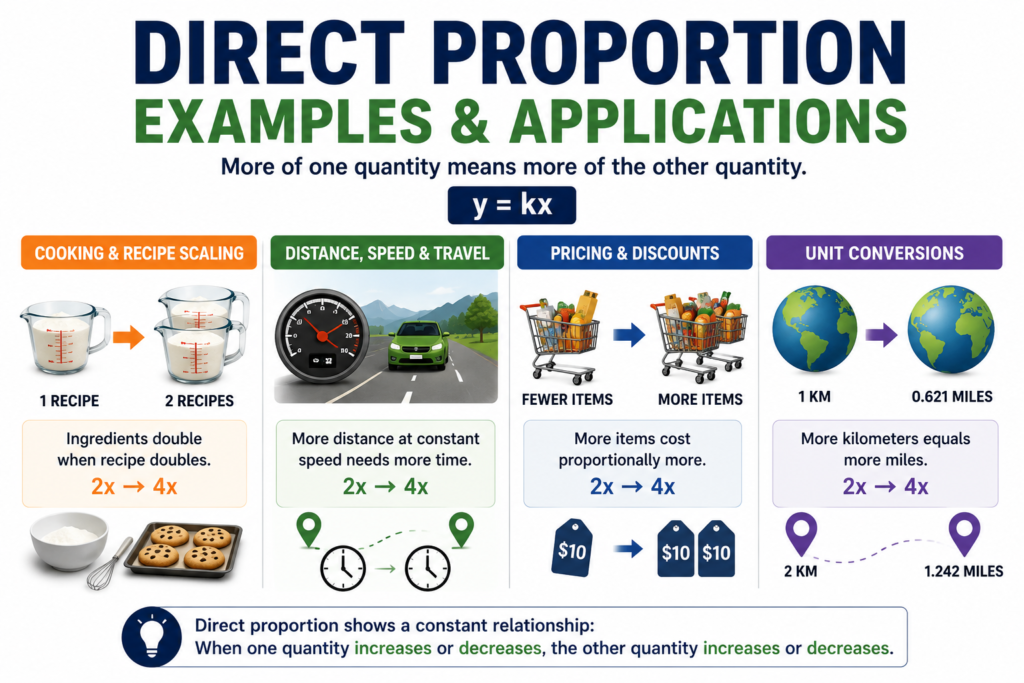
Direct Proportion Examples and Applications
Cooking and Recipe Scaling
When you double a recipe, all ingredients double proportionally. This demonstrates direct proportion perfectly. Our recipe scaling guide shows how direct proportion helps adjust servings while maintaining flavor balance.
Distance, Speed, and Travel
More distance at constant speed requires proportionally more time. A direct proportion calculator instantly converts these relationships. Learn more at our map scale calculator guide for geographic applications.
Pricing and Discounts
More items cost proportionally more at fixed prices. Our percentage and discount guide demonstrates direct proportion in business contexts.
Unit Conversions
All unit conversions using proportions rely on direct proportion—more kilometers equals more miles at a fixed conversion rate.
Inverse Proportion Examples and Applications
Work and Completion Time
More workers complete jobs faster—inverse relationship. If 5 workers take 10 days, 10 workers take 5 days. The products are equal: 5 × 10 = 10 × 5 = 50.
Pressure and Volume (Chemistry)
In gas laws, pressure and volume are inversely proportional at constant temperature. Double the pressure, the volume halves. This relationship drives chemical calculations and fundamental science education.
Speed and Travel Time
Higher speeds mean less travel time—inverse proportion. Driving 60 mph takes half the time of driving 30 mph for the same distance.
Light Intensity
Light brightness decreases with distance squared—an inverse relationship. Doubling your distance from a light source makes it 4 times dimmer.
Comparison Table: Direct vs Inverse
| Characteristic | Direct Proportion | Inverse Proportion |
|---|---|---|
| Relationship | Both increase/decrease together | One increases, other decreases |
| Formula | Y = k × X | Y = k / X |
| Graph Shape | Straight line through origin | Hyperbola curve |
| Constant Product | Ratio stays constant | Product stays constant |
| Real Example | Recipe scaling | Workers and completion time |
| Calculator Use | Standard proportion solver | Inverse calculation method |
Understanding this distinction helps you select the correct proportion calculator approach for any problem.
Step-by-Step: Recognizing Proportion Types
Direct Proportion Recognition
Question: If 3 workers build 6 walls in 12 hours, how many walls do 6 workers build in 12 hours?
Analysis:
- Same time frame (12 hours)
- Double the workers (3 → 6)
- Expect double the output (6 → 12 walls)
- This is DIRECT proportion
Solution: 6 workers build 12 walls
Inverse Proportion Recognition
Question: If 3 workers build 6 walls in 12 hours, how many hours do 6 workers need to build 6 walls?
Analysis:
- Same wall count (6 walls)
- Double the workers (3 → 6)
- Expect half the time (12 → 6 hours)
- This is INVERSE proportion
Solution: 6 workers need 6 hours
Learn cross multiplication methods to solve both types mathematically.
Formula Comparison and Calculations
| Type | Formula | Constant | Example |
|---|---|---|---|
| Direct | y = kx | Ratio k remains constant | 2 apples cost $1, so 6 apples cost $3 |
| Inverse | y = k/x | Product k remains constant | 3 workers × 12 hours = 36 worker-hours |
| Combined | y = kx/z | Multiple relationships possible | Physics equations with multiple variables |
Mastering these formulas empowers you to recognize and solve any proportion problem. Our complete proportion guide covers all formula variations comprehensively.
Common Mistakes When Identifying Proportions
| Mistake | Impact | Prevention |
|---|---|---|
| Confusing direction | Wrong calculation entirely | Ask: do both values increase or opposite? |
| Ignoring other variables | Missing actual relationships | Identify what stays constant |
| Assuming all math is proportional | Applying wrong method | Check if ratio or product stays constant |
| Calculation errors | Wrong answer despite right method | Use calculator verification |
Frequently Asked Questions
Q: How do I know which type applies to my problem?
A: Ask if both values increase together (direct) or move opposite (inverse). Our word problems guide has detailed examples.
Q: Can a problem involve both types?
A: Yes! Complex problems use combined proportions. Learn about all proportion types in our comprehensive guide.
Q: Why does this matter for word problems?
A: Recognizing proportion type determines your solution method. See our ratios vs proportions comparison for clarity.
Q: Can I use the same calculator for both?
A: Our main calculator handles direct proportions primarily; inverse requires adjusted setup.
Q: Are there other proportion types?
A: Yes! Learn about student-level proportions and advanced concepts in our educational resources.
Real-World Applications Summary
Direct Proportion Professions:
- Chefs and nutritionists (recipe scaling)
- Travel planners (distance calculations)
- Retailers (pricing)
- Designers (scaling artwork)
Inverse Proportion Professions:
- Project managers (staffing optimization)
- Scientists (physical laws)
- Engineers (system design)
- Economists (supply/demand analysis)
Conclusion
Direct and inverse proportions represent two fundamental mathematical relationships. Recognizing which applies to your situation determines solution success. Whether you’re scaling recipes, calculating map distances, or solving physics equations, understanding proportion types provides clarity.
Master both concepts using our free proportion calculator and comprehensive educational guides. Practice recognizing proportion types until they become intuitive—this skill transforms mathematics from intimidating to empowering.