Author: Umar Farooq
Date: August 15, 2026
Category: Business Math & Shopping
Read Time: 6-7 minutes
Expert Review: Business Mathematics Specialist
Quick Answer: How Can a Proportion Calculator Find a Percentage?
A proportion calculator for percentages instantly converts percentage problems into solvable equations. When you need to find a 20% discount or calculate sale prices, a proportion calculator for percentages does the math instantly. Instead of manual calculation, just enter the original price and discount percentage—get results immediately.
What Is a Proportion Calculator for Percentages?
A proportion calculator for percentages is a tool designed specifically for percentage and discount calculations. At its core, percentage math uses proportions. When you want to find 15% of $200, you’re solving a proportion: part/whole = percentage/100.
Traditional calculators handle basic math, but a proportion calculator for percentages specifically structures percentage problems as proportion equations. This makes complex discount and sales calculations straightforward.
How Proportions Calculate Percentages
Percentage problems ARE proportions. Every percentage calculation follows the same pattern: finding one value when you know the relationship between parts and wholes.
The Core Principle:
- Part / Whole = Percentage / 100
This proportion structure means a proportion calculator for percentages can solve any percentage problem. Need a discount calculator? It’s actually solving a proportion. Need to find sale prices? Proportions do the work.
Understanding this connection shows why proportion calculators work so powerfully for percentage math.
Percentage & Discount Formulas
Percentage Calculation Formula
Percentage = (Part ÷ Whole) × 100
Discount Calculation Formula
Discount Amount = Original Price × Discount % ÷ 100
Sale Price Formula
Sale Price = Original Price – Discount Amount
Alternative Approach (Proportion Method)
Original Price / 100 = Sale Price / (100 – Discount %)
A proportion calculator for percentages automates all these calculations. Instead of manual arithmetic, enter values and get results.
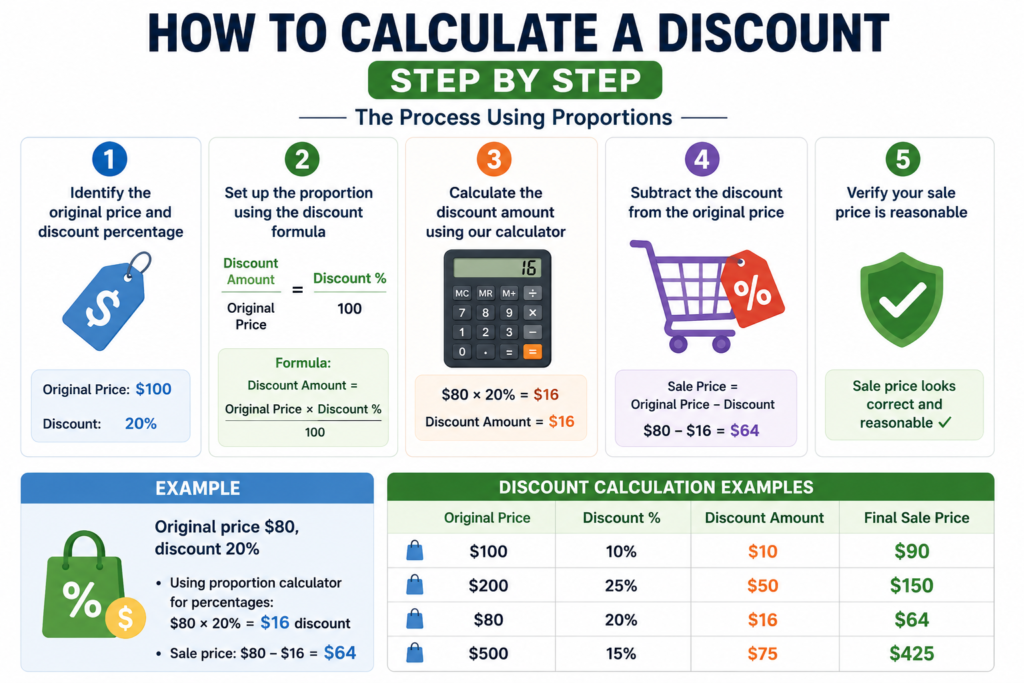
How to Calculate a Discount Step by Step
The Process Using Proportions
Step 1: Identify the original price and discount percentage
Step 2: Set up the proportion using the discount formula
Step 3: Calculate the discount amount using our calculator
Step 4: Subtract the discount from the original price
Step 5: Verify your sale price is reasonable
Example: Original price $80, discount 20%
- Using proportion calculator for percentages: $80 × 20% = $16 discount
- Sale price: $80 – $16 = $64
| Original Price | Discount % | Discount Amount | Final Sale Price |
|---|---|---|---|
| $100 | 10% | $10 | $90 |
| $200 | 25% | $50 | $150 |
| $80 | 20% | $16 | $64 |
| $500 | 15% | $75 | $425 |
How to Find the Sale Price
Sale price calculation is the most common use for a discount calculator. A proportion calculator for percentages makes this instant.
Manual Process: Multiply original price by discount %, subtract from original.
Calculator Process: Enter original price and discount %, click calculate—get sale price immediately.
Real Scenario: Store advertises 30% off everything. Item normally costs $150. Using proportion-based discount calculator: $150 – ($150 × 30%) = $105 final price.
Real-World Percentage Examples
Shopping Discounts
Store has 25% off sale. Your cart is $80. Sale price using proportion-based calculation: $80 × 75% = $60.
Retail Markups
Wholesale cost $20, store wants 40% markup. Retail price: $20 × 140% = $28. Proportion calculator for percentages handles this instantly.
Sales Tax
Item costs $50, sales tax is 8%. Total using proportions: $50 × 1.08 = $54. Tax amount: $4.
Commissions
Salesperson earns 5% commission on $10,000 sale. Commission: $10,000 × 5% = $500. Proportion methods calculate this instantly.
Business & Shopping Applications
| Application | Calculation | Why Proportions Help |
|---|---|---|
| Discount Pricing | Original × (100 – Discount %) ÷ 100 | Instant sale prices |
| Markup Calculations | Cost × (100 + Markup %) ÷ 100 | Quick retail pricing |
| Sales Tax | Original × Tax % | Automatic totals |
| Commission | Sales × Commission % | Fast payroll |
| Percentage Change | (New – Old) ÷ Old × 100 | Track growth |
A proportion calculator for percentages handles all these automatically.
Percentage Increase and Decrease
Percentage Increase Formula: Increase = Original × (100 + Increase %) ÷ 100
Percentage Decrease Formula: Decrease = Original × (100 – Decrease %) ÷ 100
Example: Investment worth $1,000 grows 12%. New value: $1,000 × 1.12 = $1,120.
A discount calculator or proportion calculator for percentages handles percentage increases identically to discounts—just change the framing.
Common Percentage and Discount Mistakes
| Mistake | Problem | Solution |
|---|---|---|
| Wrong base value | Calculating % of wrong amount | Double-check original price |
| Mixing decimals/percents | 20 vs 0.20 confusion | Convert consistently before calculating |
| Rounding too early | Accumulating small errors | Round only final answer |
| Forgetting to subtract | Getting discount instead of sale price | Verify with proportion method |
Using a proportion calculator for percentages eliminates most errors automatically.
Frequently Asked Questions
Q: How do I calculate a 20% discount? A: A proportion calculator for percentages calculates automatically. Or manually: Original Price × 20% = Discount Amount, then subtract from original.
Q: Can a discount calculator handle multiple discounts? A: Yes. Apply first discount, then apply second discount to the new price. Proportion methods stack sequentially.
Q: How do I find the original price from a sale price? A: Use the reverse proportion: Sale Price / (100 – Discount %) × 100 = Original. A proportion calculator for percentages can solve this.
Q: What’s the difference between markup and discount? A: Markup adds to cost (retail pricing). Discount subtracts from original (sales). Proportions handle both identically.
Q: Can proportions calculate percentage increases? A: Absolutely. Percentage increase uses the same proportion structure as discount calculations—just add instead of subtract.
Conclusion
Percentage math becomes simple when you understand it as proportion solving. Whether calculating store discounts, business markups, or financial percentages, a proportion calculator for percentages provides instant, accurate results. Learn the concepts, use our free proportion calculator for verification, and master percentage math completely.
For deeper understanding, explore our complete proportion guide detailed proportion solving methods.