Introduction
Among the most common sources of mathematical confusion, the distinction between ratios and proportions ranks high. Students often struggle to understand how they differ, when to use each one, and why it matters. The truth is simple: understanding the difference between ratios vs proportions unlocks a crucial mathematical concept that applies everywhere from cooking to business to science.
This comprehensive guide clarifies the distinction between ratios vs proportions, explores their relationship, provides clear definitions, and demonstrates practical applications. By the end, the confusion disappears, replaced by solid understanding.
Ratio Definition: Understanding the Basics
A ratio is a mathematical comparison between two quantities, showing how many times one value contains another. More simply, a ratio expresses the relative size of two quantities.
Ratio Definition in Practical Terms: If someone says “the ratio of boys to girls in a class is 3:2,” this means for every 3 boys, there are 2 girls. The ratio shows the relationship between quantities but doesn’t establish an equation.
Key Characteristics of Ratios
- Compares Two Quantities: Ratios always compare exactly two values
- Shows Relationship: Indicates how quantities relate to each other
- Multiple Formats: Can be written as 3:2, 3 to 2, or 3/2
- Simplifiable: Ratios can be reduced (6:4 = 3:2)
- No Equation: A ratio is just a comparison, not an equation setting two things equal
Examples of Ratios
- Recipe ingredients: “Add sugar to flour in a 1:3 ratio”
- Probability: “The odds are 5:1 in favor”
- Scaling: “Map scale is 1 inch to 50 miles”
- Business metrics: “Profit to revenue ratio is 1:4”
Proportion Definition: Establishing Equality
A proportion is a statement that two ratios are equal. While a ratio compares two quantities, a proportion states that two different ratios are identical. This distinction forms the core of ratios vs proportions understanding.
Proportion Definition in Practical Terms: If someone writes “3:2 = 6:4,” they’re stating a proportion—claiming these two ratios are equivalent. Two ratios form a proportion when their cross products are equal.
Key Characteristics of Proportions
- Compares Two Ratios: Proportions always involve two ratios
- Establishes Equation: Shows that two ratios equal each other
- Solvable for Unknowns: Used to find missing values
- Mathematical Relationship: Ratios vs proportions differ because proportions are mathematical equations
- Real-World Problem Solving: Proportions solve practical problems with missing values
Examples of Proportions
- Recipe scaling: “2 servings : 3 cups flour = 4 servings : x cups flour”
- Distance calculation: “1 inch : 50 miles = 3 inches : x miles”
- Currency exchange: “1 USD : 85 INR = 50 USD : x INR”
- Business pricing: “8 items : $96 = 20 items : x dollars”
Ratios vs Proportions: Key Differences
Understanding how ratios vs proportions differ clarifies when and how to use each concept.
Difference 1: Structure and Definition
Ratios: A ratio definition describes a simple comparison between two quantities. It answers “what is the relationship?” but not “how many?”
Proportions: A proportion definition states that two ratios are equal. It answers “if this ratio holds here, what’s the missing value there?”
This fundamental difference between ratios vs proportions shapes their applications.
Difference 2: Purpose and Application
Ratios: Used when describing relationships or relative sizes. A ratio definition helps express how quantities relate without necessarily solving for unknowns.
Proportions: Used specifically for solving problems. When someone knows three values in a proportion and needs to find the fourth, they’re using proportion definition practically.
Difference 3: Mathematical Expression
Ratios: Written as a:b or a/b. They don’t involve an equals sign (unless comparing multiple ratios).
Proportions: Always written with an equals sign: a/b = c/d. This equality distinguishes proportions from simple ratios.
Difference 4: Number of Ratios Involved
Ratios: Compare exactly two quantities in one ratio.
Proportions: Compare two ratios simultaneously, making it a comparison of comparisons.
Ratios vs Proportions: Similarities
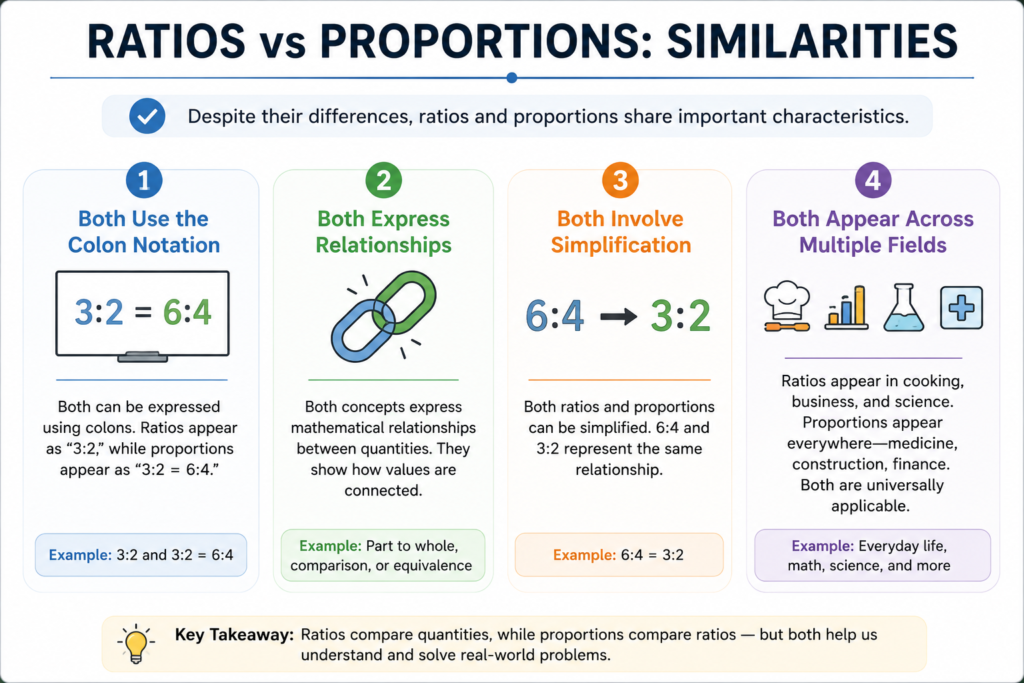
Despite their differences, ratios and proportions share important characteristics.
Similarity 1: Both Use the Colon Notation
Both can be expressed using colons. Ratios appear as “3:2,” while proportions appear as “3:2 = 6:4.”
Similarity 2: Both Express Relationships
Whether discussing a single ratio or a proportion, both concepts express mathematical relationships between quantities. Understanding ratio definition and proportion definition together reveals how interconnected they are.
Similarity 3: Both Involve Simplification
Both ratios and proportions can be simplified. In ratios vs proportions discussions, recognizing that 3:2 and 6:4 represent the same relationship is crucial.
Similarity 4: Both Appear Across Multiple Fields
Ratios appear in cooking, business, and science. Proportions appear everywhere—medicine, construction, finance. Both concepts are universally applicable.
When to Use Ratios vs Proportions
Choosing between ratios vs proportions depends on what information someone has and what they need to find.
Use Ratios When:
- Describing Relationships: “The team has a win-loss ratio of 5:3”
- Expressing Proportional Parts: “The recipe calls for a 2:3 flour-to-sugar ratio”
- Showing Comparisons: “The employee-to-manager ratio is 8:1”
- No Unknown Values: When simply expressing how quantities relate
- Establishing Standards: “Professional aspect ratios in photography are 3:2 or 4:3”
Use Proportions When:
- Finding Missing Values: “If 4 items cost $20, how much do 10 items cost?”
- Scaling Recipes: “A recipe serves 4 with 2 cups flour; how much flour for 6 servings?”
- Converting Units: “1 inch equals 50 miles on a map; 3 inches equals how many miles?”
- Solving Problems: Any situation requiring calculation of an unknown fourth value
- Cross Multiplication: When using the mathematical property that a/b = c/d means a×d = b×c
Real-World Examples Comparing Ratios vs Proportions
Example 1: Cooking
Ratio Usage: “Mix paint in a 3:1 ratio of red to white”
- This simply describes the relationship
Proportion Usage: “If 3 parts red and 1 part white makes 4 total parts, how much red for 20 total parts?”
- This solves for a specific unknown value
The difference between ratios vs proportions becomes clear: one describes, the other calculates.
Example 2: Business Pricing
Ratio Usage: “Our profit-to-sales ratio is 1:5”
- Describes financial relationship
Proportion Usage: “If 8 items sell for $96, what’s the price for 20 items?”
- Solves for specific cost
Example 3: Map Reading
Ratio Usage: “The map scale is 1:50,000”
- Establishes the relationship between map and reality
Proportion Usage: “If 1 inch equals 50 miles, how far is a 3-inch distance?”
- Calculates actual distance
Example 4: Chemistry
Ratio Usage: “The molecular ratio of hydrogen to oxygen in water is 2:1”
- Describes chemical composition
Proportion Usage: “If we have 4 atoms of hydrogen, how many oxygen atoms in pure water?”
- Solves for specific quantities
Common Confusion Points
Confusion 1: Assuming Ratios Always Solve Problems
Ratios describe relationships but don’t inherently solve problems. Proportions solve problems by establishing that two ratios are equal.
Confusion 2: Mixing Up Terminology
Some people use “ratio” and “proportion” interchangeably, but they’re distinct concepts. Understanding ratio definition versus proportion definition prevents this error.
Confusion 3: Forgetting That Proportions Contain Ratios
Every proportion contains two ratios. Understanding ratios vs proportions means recognizing that proportions are built from ratios.
Confusion 4: Not Recognizing Equivalent Ratios
In ratios vs proportions discussions, recognizing that 2:3, 4:6, and 6:9 all represent the same ratio is crucial for working with proportions.
Practical Problem-Solving: Ratios vs Proportions in Action
Scenario 1: Recipe Scaling
Given Information: A cookie recipe serves 12 people using 3 cups flour
Using Ratio: The ratio of servings to flour is 12:3 (or simplified, 4:1)
Using Proportion: To find flour needed for 20 servings, set up: 12/3 = 20/x
- Solving: 12x = 3 × 20 = 60, so x = 5 cups
Scenario 2: Travel Distance
Given Information: A car travels 120 miles in 2 hours
Using Ratio: The ratio of distance to time is 120:2 (or 60:1, representing 60 mph)
Using Proportion: To find distance traveled in 5 hours, set up: 120/2 = x/5
- Solving: 2x = 120 × 5 = 600, so x = 300 miles
Learning Tips for Mastering Ratios vs Proportions
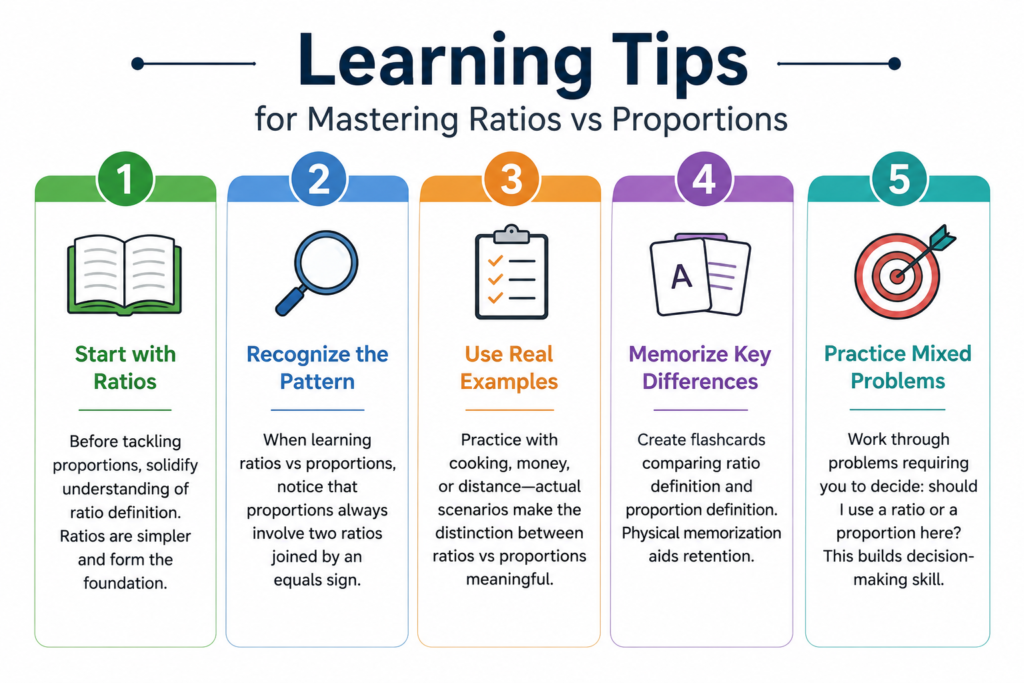
Tip 1: Start with Ratios
Before tackling proportions, solidify understanding of ratio definition. Ratios are simpler and form the foundation.
Tip 2: Recognize the Pattern
When learning ratios vs proportions, notice that proportions always involve two ratios joined by an equals sign.
Tip 3: Use Real Examples
Practice with cooking, money, or distance—actual scenarios make the distinction between ratios vs proportions meaningful.
Tip 4: Memorize Key Differences
Create flashcards comparing ratio definition and proportion definition. Physical memorization aids retention.
Tip 5: Practice Mixed Problems
Work through problems requiring you to decide: should I use a ratio or a proportion here? This builds decision-making skill.
Conclusion
The confusion between ratios vs proportions stems from their relationship—proportions are built from ratios. However, they serve different purposes: ratios describe relationships, while proportions solve problems involving equal ratios.
Mastering the distinction between ratio definition and proportion definition opens mathematical doors. From scaling recipes to calculating distances, from chemistry to business, understanding when to use ratios vs proportions makes problem-solving efficient and accurate.
Remember: a ratio is a comparison. A proportion is a statement that two ratios are equal. Keep this core distinction clear, practice with real examples, and the concepts that once seemed confusing become intuitive and practical tools for everyday problem-solving.
Written by: Umar Farooq
Reviewed by: Math Expert
Last Updated: 14 August 2026
Pingback: Understanding Cross Multiplication in Proportions: Complete Tutorial - Prime Calculator