Introduction
Mathematics often feels intimidating, especially when dealing with proportions and ratios. However, learning how to work with proportional relationships doesn’t require advanced calculus or complex formulas. With the right approach, anyone can master this fundamental skill.
This guide breaks down the process of solving proportion problems into manageable, easy-to-follow steps. Whether someone is tackling school assignments or solving real-world problems, understanding these methods transforms what seems complicated into something straightforward and even enjoyable.
What Are Proportions?
Before diving into solving techniques, it’s important to understand what proportions actually are. A proportion is a statement showing that two ratios are equal. When written mathematically, it looks like this: a/b = c/d.
In simpler terms, imagine a recipe. If 2 cups of flour make 12 cookies, then 4 cups of flour would make 24 cookies. This relationship—the ratio of flour to cookies—remains constant. That’s a proportion in action.
Proportions appear everywhere: in cooking, construction, photography, medicine, and business. Mastering this skill opens doors to practical problem-solving across countless situations.
The Four Simple Steps to Solving Proportions
Step 1: Identify and Write Out the Proportion
The first step in solving proportions is clearly identifying what you’re working with. Look at your problem and determine which values are known and which need to be found.
Write the proportion in the standard format: a/b = c/d, where one value is unknown (usually represented by x).
Example: If 3 books cost $24, how much do 8 books cost?
Write this as: 3/24 = 8/x
This simple setup prevents confusion and ensures you’re working with the correct values from the start.
Step 2: Set Up Cross Multiplication
Once the proportion is written, the next step involves using a powerful mathematical technique. Cross multiplication is the backbone of proportion solving. When you have two ratios equal to each other, you multiply the numerator of the first fraction by the denominator of the second, and vice versa.
Using our example: 3/24 = 8/x
Cross multiply:
- 3 × x = 24 × 8
- 3x = 192
This technique works because of a fundamental property in mathematics: if two fractions are equal, then cross-multiplying produces equal products.
Step 3: Solve the Resulting Equation
After cross multiplication, you’re left with a simple algebraic equation. This is where basic algebra takes over from proportion-specific techniques.
Continuing our example:
- 3x = 192
- Divide both sides by 3
- x = 64
So 8 books cost $64.
The key here is isolating the variable (x) by performing the same operation on both sides of the equation. This maintains the equation’s balance.
Step 4: Check Your Answer
Never skip verification. Checking ensures accuracy and builds confidence in your solution.
Substitute your answer back into the original proportion: 3/24 = 8/64
Simplify both fractions: 1/8 = 1/8 ✓
Both sides are equal, confirming the answer is correct.
Understanding Cross Multiplication Deeply
Cross multiplication isn’t just a magic trick—it’s based on solid mathematical principles. When two fractions are equal, their cross products must also be equal.
Think of it this way: a/b = c/d becomes a × d = b × c.
This property makes solving ratio problems efficient and reliable. Understanding the “why” behind the method helps prevent mistakes and builds mathematical intuition.
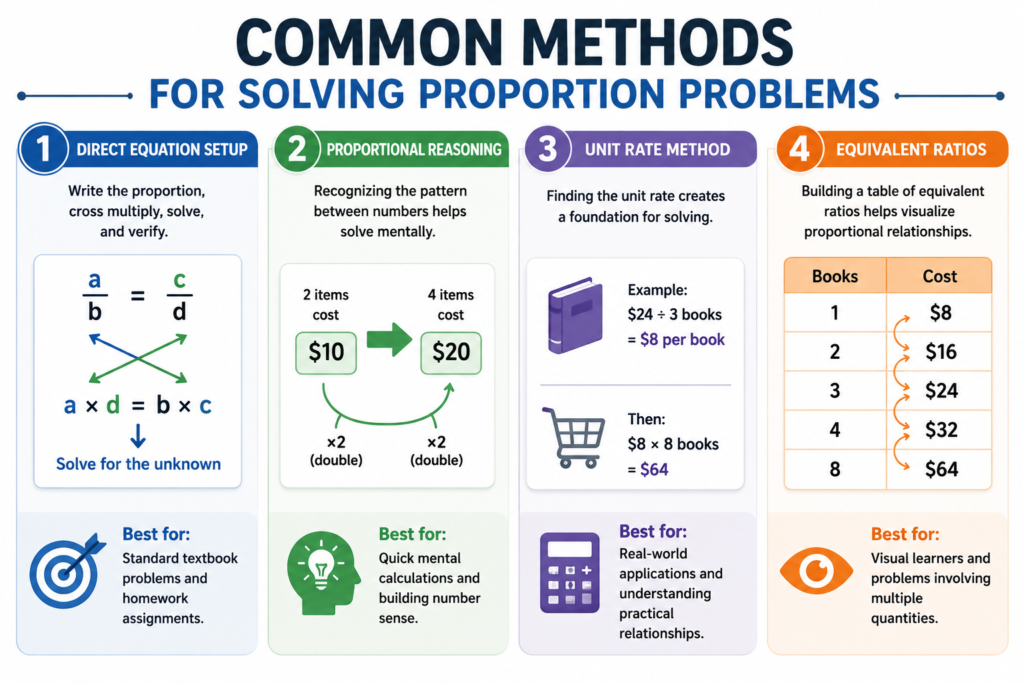
Common Methods for Solving Proportion Problems
Method 1: Direct Equation Setup
This is what we’ve already covered. Write the proportion, cross multiply, solve, and verify.
Best for: Standard textbook problems and homework assignments.
Method 2: Proportional Reasoning
Sometimes, recognizing the pattern between numbers helps solve problems mentally.
If 2 items cost $10, then 4 items (double the quantity) cost $20 (double the price). This intuitive approach works well for problems with simple numbers.
Best for: Quick mental calculations and building number sense.
Method 3: Unit Rate Method
Finding the unit rate (cost per item, miles per hour, etc.) creates a foundation for solving.
In our book example: $24 ÷ 3 books = $8 per book
Then: $8 × 8 books = $64
Best for: Real-world applications and understanding practical relationships.
Method 4: Equivalent Ratios
Building a table of equivalent ratios helps visualize proportional relationships.
| Books | Cost |
|---|---|
| 1 | $8 |
| 2 | $16 |
| 3 | $24 |
| 4 | $32 |
| 8 | $64 |
Best for: Visual learners and problems involving multiple quantities.
Real-World Examples of Solving Proportion Problems
Example 1: Recipe Scaling
A cake recipe serves 6 people and requires 3 eggs. How many eggs are needed to serve 15 people?
Setup: 6/3 = 15/x
Solution:
- 6x = 3 × 15 = 45
- x = 7.5 eggs
Answer: You’d need 7.5 eggs (or 7-8 eggs in practice).
Example 2: Map Distance Calculation
On a map, 1 inch equals 50 miles. If two cities are 4 inches apart on the map, what’s the actual distance?
Setup: 1/50 = 4/x
Solution:
- 1 × x = 50 × 4 = 200
- x = 200 miles
Answer: The cities are 200 miles apart.
Example 3: Speed and Distance
A car travels 150 miles in 3 hours. At the same speed, how far will it travel in 7 hours?
Setup: 150/3 = x/7
Solution:
- 150 × 7 = 3 × x
- 1050 = 3x
- x = 350 miles
Answer: The car will travel 350 miles in 7 hours.
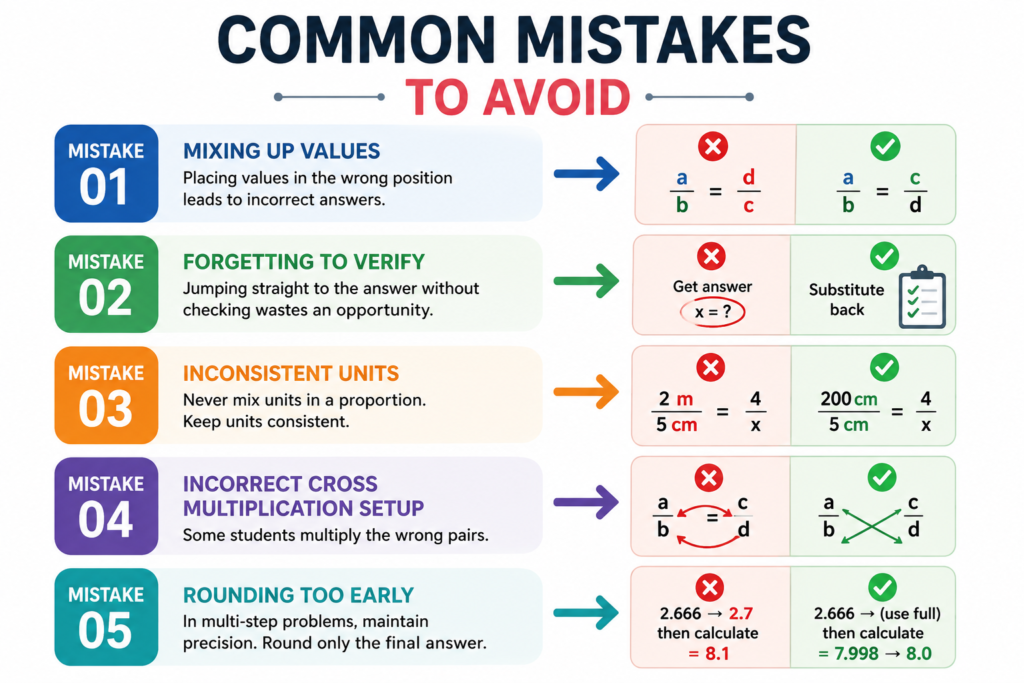
Common Mistakes to Avoid
Mistake 1: Mixing Up Values
Placing values in the wrong position leads to incorrect answers. Always ensure corresponding values align properly. Numerators should represent the same type of quantity, as should denominators.
Mistake 2: Forgetting to Verify
Jumping straight to the answer without checking wastes an opportunity to catch errors. Always substitute back into the original proportion.
Mistake 3: Inconsistent Units
Never mix units in a proportion. If comparing dollars to dollars, keep both in the same currency. If comparing inches to inches, maintain consistency.
Mistake 4: Incorrect Cross Multiplication Setup
Some students multiply the wrong pairs. Remember: multiply diagonally across the equal sign.
Mistake 5: Rounding Too Early
In multi-step problems, maintain precision throughout calculations. Round only the final answer if necessary.
When Proportions Work and When They Don’t
Not every relationship is proportional. Recognizing which situations involve true proportional relationships is crucial.
Proportional relationships:
- Recipe scaling (ingredients scale together)
- Map distances (all distances scale equally)
- Speed calculations (distance scales with time)
Non-proportional relationships:
- Age and height (children grow, then stop)
- Study time and test scores (effort helps, but diminishing returns exist)
- Weight and age (no consistent relationship)
Practice Tips for Mastering This Skill
Start With Simple Problems
Begin with straightforward problems involving whole numbers. This builds confidence before tackling decimals or fractions.
Use Multiple Methods
Practice using different approaches. Understanding several methods deepens comprehension and flexibility.
Work Real Problems
Use actual recipes, maps, and real-world scenarios. Practical application reinforces learning better than abstract exercises.
Explain Your Thinking
Teaching others (or explaining to yourself) reveals gaps in understanding and solidifies knowledge.
Practice Consistently
Like any skill, solving proportions improves with regular practice. Dedicate time each day or week to working through problems.
Why This Skill Matters
Understanding how to solve proportion problems extends far beyond mathematics class. This skill applies to cooking, construction, medicine, business, photography, and countless other fields.
Professionals in every industry use proportional reasoning daily. Scientists balance chemical equations. Nurses calculate medication dosages. Photographers maintain aspect ratios. Business owners analyze profit margins.
By mastering this fundamental skill, individuals unlock practical capabilities that serve them throughout their lives.
Conclusion
Learning how to approach proportions transforms what initially seems challenging into a manageable, logical process. The four-step method—identify, cross multiply, solve, and verify—provides a reliable framework for tackling any proportion problem.
Whether someone is a student completing homework, a professional applying math to their work, or someone simply wanting to strengthen mathematical skills, these techniques work universally. The key is understanding not just the “how” but also the “why” behind the methods.
With practice and patience, solving proportions becomes second nature. What once felt complex now feels intuitive. This progression is exactly what mathematical learning should be—starting with structured methods and eventually developing the ability to solve problems fluidly and confidently.
Pingback: Proportion Calculator for Homework Help: Middle School Math - Prime Calculator