Author: Umar Farooq
Date: August 15, 2026
Category: Middle School Math Education
Read Time: 5-6 minutes
Introduction
Sixth, seventh, and eighth-grade students face a crucial mathematical milestone: mastering proportions. Understanding how proportions work opens doors to algebra, geometry, and countless real-world problem-solving abilities. However, many students struggle with the concept. A proportion calculator for students removes the computational stress, allowing learners to focus on understanding the underlying mathematics.
This guide helps middle school math students understand proportions, provides a free proportion calculator for students, and offers strategies for acing proportion homework and tests.
Why Middle School Math Requires Proportion Understanding
Proportions form the foundation for advanced mathematics. In middle school math, students encounter proportions in:
- Ratios and rates – comparing quantities
- Scale models – understanding blueprints and maps
- Similar figures – geometry foundations
- Percentages – discount calculations and statistics
A proportion calculator for students becomes an invaluable study tool during these critical learning years.
What Students Need to Know About Proportions
Definition for Students
A proportion states that two ratios are equal. Written as a/b = c/d, it expresses that “a is to b as c is to d.”
Simple Example: If 2 apples cost $3, how much do 4 apples cost?
- Setup: 2/3 = 4/x
- This is a proportion
Key Concept: Cross Multiplication
The most important middle school math technique for solving proportions is cross multiplication:
- Multiply diagonally: 2 × x = 3 × 4
- Solve: 2x = 12, so x = 6
A proportion calculator for students automates this, but understanding the method matters more.
How to Use a Proportion Calculator for Students
Step-by-Step Process
| Step | Action | Example |
|---|---|---|
| 1 | Identify known values | 2 apples, $3, 4 apples |
| 2 | Set up the proportion | 2/3 = 4/x |
| 3 | Enter into calculator | Input: 2, 3, 4 in calculator |
| 4 | Calculate | Calculator shows: x = 6 |
| 5 | Verify answer | Check: 2/3 = 4/6? Yes! ✓ |
When to Use a Proportion Calculator for Students
- Homework verification: Check manual calculations
- Understanding concepts: See step-by-step solutions
- Test preparation: Practice with various numbers
- Learning support: Build confidence in middle school math
Common Proportion Homework Problems for Students
Problem Type 1: Recipe Scaling
Question: A smoothie recipe serves 3 people using 2 bananas. How many bananas for 9 people?
Setup: 3/2 = 9/x
Using proportion calculator for students: Input these values, get x = 6 bananas
Why it matters: Teaches real-world applications of middle school math
Problem Type 2: Distance and Maps
Question: On a map, 1 inch = 50 miles. If cities are 3 inches apart, what’s the actual distance?
Setup: 1/50 = 3/x
Using proportion calculator for students: Get x = 150 miles
Real application: Helps students understand scale in geography and travel
Problem Type 3: Shopping and Discounts
Question: If 4 shirts cost $80, how much do 7 shirts cost?
Setup: 4/80 = 7/x
Using proportion calculator for students: Get x = $140
Practical skill: Essential for budgeting and consumer math in middle school math
Proportion Homework Strategies for Students
Strategy 1: Organize Information Clearly
Create a table before using a proportion calculator for students:
| What We Know | What We Want |
|---|---|
| 4 shirts = $80 | 7 shirts = ? |
| 2 cups flour serves 3 people | 8 cups flour serves ? |
Strategy 2: Check If Proportions Make Sense
Before using a proportion calculator for students, ask:
- “If I have more items, should the cost increase?” (Yes = direct proportion)
- “If I have more workers, should completion time decrease?” (Yes = inverse proportion)
Strategy 3: Practice with Similar Problems
Once you understand one type of proportion homework, variations become easier. Practice multiple examples of each type.
Strategy 4: Use Mental Math First
Try estimating the answer before using a proportion calculator for students. This develops number sense and helps catch calculator errors.
Free Online Resources for Middle School Math
Using Free online proportion calculator
PrimeCalculator provides a free, no-signup-required proportion calculator for students with:
- Step-by-step solutions
- Mobile-friendly interface
- Instant verification
- Real-world examples
Complementary Learning Resources
Students benefit from understanding the concepts behind calculations:
- Learn how to solve proportions step-by-step
- Understand the difference between ratios and proportions
- Master proportion word problems
Study Tips for Acing Proportion Tests
Before the Test
- Practice consistently: Solve 5-10 proportion problems daily for 2 weeks before tests
- Use proportion calculator for students to verify: Check your work, then try without the calculator
- Understand common mistakes: Review problems you got wrong
- Teach someone else: Explaining helps solidify understanding
During the Test
- Show your work: Teachers award points for methodology, not just answers
- Set up proportions carefully: Misplacement of values causes most errors
- Check your answer: Does it make logical sense?
- Manage time: Don’t spend excessive time on one problem
Test-Taking Strategy Table
| Situation | What to Do | Why It Helps |
|---|---|---|
| Stuck on problem | Skip, return later | Prevents time waste |
| Answer seems wrong | Verify setup first | Usually catches the error |
| Multiple answers given | Try each option | Find which satisfies the proportion |
| Time running out | Complete remaining problems | Get partial credit |
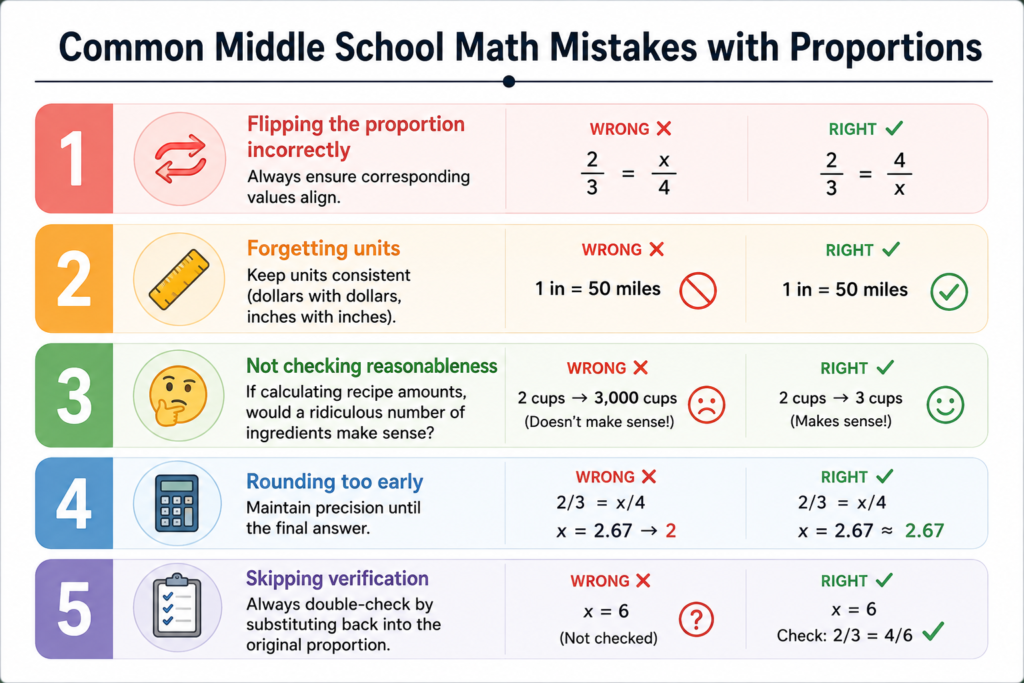
Common Middle School Math Mistakes with Proportions
Mistake 1: Flipping the proportion incorrectly – Always ensure corresponding values align
Mistake 2: Forgetting units – Keep units consistent (dollars with dollars, inches with inches)
Mistake 3: Not checking reasonableness – If calculating recipe amounts, would a ridiculous number of ingredients make sense?
Mistake 4: Rounding too early – Maintain precision until the final answer
Mistake 5: Skipping verification – Always double-check by substituting back into the original proportion
Building Proportion Confidence
A proportion calculator for students should enhance learning, not replace understanding. The best approach:
- Learn the concept using tutorials
- Practice manually to build skills
- Use proportion calculator for students to verify work
- Gradually reduce calculator dependence as confidence grows
This progression ensures students master middle school math thoroughly.
Conclusion
Proportion homework doesn’t need to be stressful. With a free proportion calculator for students and proper understanding, sixth through eighth graders can approach these problems confidently. The key is balancing tool usage with conceptual understanding—using the calculator as a learning aid rather than a shortcut.
By mastering proportions in middle school math now, students build a strong foundation for higher mathematics and develop problem-solving skills they’ll use throughout their academic careers and professional lives.