Introduction
Scaling is one of the most practical applications of proportional mathematics. Whether someone needs to adjust recipe ingredients, enlarge architectural drawings, or resize artwork, the fundamental mathematical principle remains constant: maintaining proper proportional relationships. A proportion calculator for scaling simplifies this process, transforming what could be complex calculations into simple, accurate results.
This comprehensive guide explores how scaling proportions work, demonstrates how a scale factor calculator helps solve real problems, and provides practical methods for recipe scaling and beyond. From the kitchen to the construction site to the art studio, understanding scaling proportions makes these tasks effortless.
What Is Scaling and Why Proportions Matter
Scaling means adjusting something to a different size while maintaining its proportional relationships. When something is scaled, all dimensions change by the same factor. A proportion calculator for scaling ensures this consistency.
For example, if a recipe serves 4 people, and someone needs to serve 8, they’re scaling by a factor of 2. Every ingredient doubles. This is where scaling proportions becomes essential—maintaining the ratio between ingredients ensures the dish tastes correct regardless of serving size.
In architecture, a blueprint might scale down a 50-foot building into a drawing that fits on paper. The scale factor calculator determines that every 1 inch on the blueprint represents 50 feet in reality. Scaling proportions keep the building’s proportions correct in miniature.
Understanding Scale Factor Calculator Basics
A scale factor calculator determines how much larger or smaller something becomes. It’s the number by which all dimensions are multiplied.
How Scale Factor Calculator Works
Formula: New Measurement = Original Measurement × Scale Factor
If a recipe calls for 2 cups flour and needs to be doubled:
- Scale Factor = 2
- New Flour Amount = 2 cups × 2 = 4 cups
A scale factor calculator automates this multiplication, especially useful with decimals or complex fractions.
Common Scale Factors
- 2x: Doubling (scale factor = 2)
- 0.5x: Halving (scale factor = 0.5)
- 1.5x: Increasing by 50% (scale factor = 1.5)
- 1:2: Reducing to half size (scale factor = 0.5)
Recipe Scaling: A Practical Guide
Recipe scaling represents the most common everyday use of scaling proportions. Cooking shows, meal prep, and catering all depend on accurate recipe scaling.
How Recipe Scaling Works
Original recipe serves 4 people with these ingredients:
- 2 cups flour
- 1 cup sugar
- 3/4 cup butter
- 2 eggs
To serve 6 people, the scale factor is 6÷4 = 1.5
Using a scale factor calculator for recipe scaling:
- Flour: 2 × 1.5 = 3 cups
- Sugar: 1 × 1.5 = 1.5 cups
- Butter: 0.75 × 1.5 = 1.125 cups (approximately 1⅛ cups)
- Eggs: 2 × 1.5 = 3 eggs
A proportion calculator for scaling handles decimal conversions automatically, essential for recipe scaling accuracy.
Recipe Scaling Challenges
Some ingredients don’t scale linearly. Spices, seasonings, and salt need less aggressive scaling. A recipe scaled 4x shouldn’t quadruple the salt—it would become inedible. Understanding which ingredients need adjusted scaling proportions comes with experience.
Scaling Proportions in Architecture and Construction
Architects and builders use scaling proportions constantly. Blueprint scales like 1:100 (meaning 1 unit on paper equals 100 units in reality) determine all construction calculations.
Using Scale Factor Calculator in Architecture
If a blueprint scale is 1:50 and a room measures 2.5 inches on the blueprint:
- Actual measurement = 2.5 × 50 = 125 inches (approximately 10.4 feet)
A scale factor calculator handles this instantly, preventing costly measurement errors.
Blueprint Scaling Methods
1:100 Scale: Common for residential buildings, 1 inch = 100 inches (8.33 feet)
1:50 Scale: Detailed plans, 1 inch = 50 inches (approximately 4.2 feet)
1:200 Scale: Site plans and larger structures
Understanding scaling proportions ensures blueprints accurately represent actual buildings.
Scaling Artwork and Images
Artists, photographers, and designers constantly scale images while maintaining proportions. Incorrect scaling distorts images.
Understanding Aspect Ratio in Scaling Proportions
Aspect ratio is the proportion between width and height. A 4:3 ratio means for every 4 units wide, the image is 3 units tall.
When scaling artwork:
- Original: 8 inches wide, 6 inches tall (4:3 ratio)
- Scale factor for 50% reduction: 0.5
- New size: 4 inches wide, 3 inches tall (maintains 4:3 ratio)
A proportion calculator for scaling ensures aspect ratios stay correct, preventing stretched or squeezed images.
Common Scaling Scenarios in Art
Digital Images: Resizing for web, print, or social media
Canvas Enlargement: Scaling a sketch to larger canvas size
Proportion Maintenance: Ensuring sculptures maintain correct proportions when enlarged
Percentage Scaling and Enlargement Calculations
Sometimes scaling is expressed as percentages. Understanding this connection to scaling proportions is essential.
Percentage to Scale Factor Conversion
- 50% increase = Scale factor 1.5 (multiply by 1.5)
- 25% increase = Scale factor 1.25
- 50% decrease = Scale factor 0.5 (multiply by 0.5)
- 75% decrease = Scale factor 0.25
Practical Percentage Scaling Example
A business wants to enlarge a logo by 25%.
Original logo: 2 inches wide, 1.5 inches tall
Using scaling proportions with percentage:
- Scale factor = 1.25
- New width: 2 × 1.25 = 2.5 inches
- New height: 1.5 × 1.25 = 1.875 inches
A scale factor calculator eliminates manual percentage calculations.
Using Technology: Digital Tools for Scaling
Modern proportion calculator tools make scaling effortless across various applications.
Online Proportion Calculator for Scaling
Web-based calculators accept original and desired measurements, automatically calculating scaling proportions and scale factors.
Input: Original measurements and desired scale Output: New measurements, scale factor, and verification calculations
Built-In Scaling Tools
Photo Editing Software: Automatically maintains aspect ratios during scaling proportions
Design Software: Allows percentage or exact measurement scaling proportions
Spreadsheet Applications: Formula-based scaling calculations for recipe scaling or construction measurements
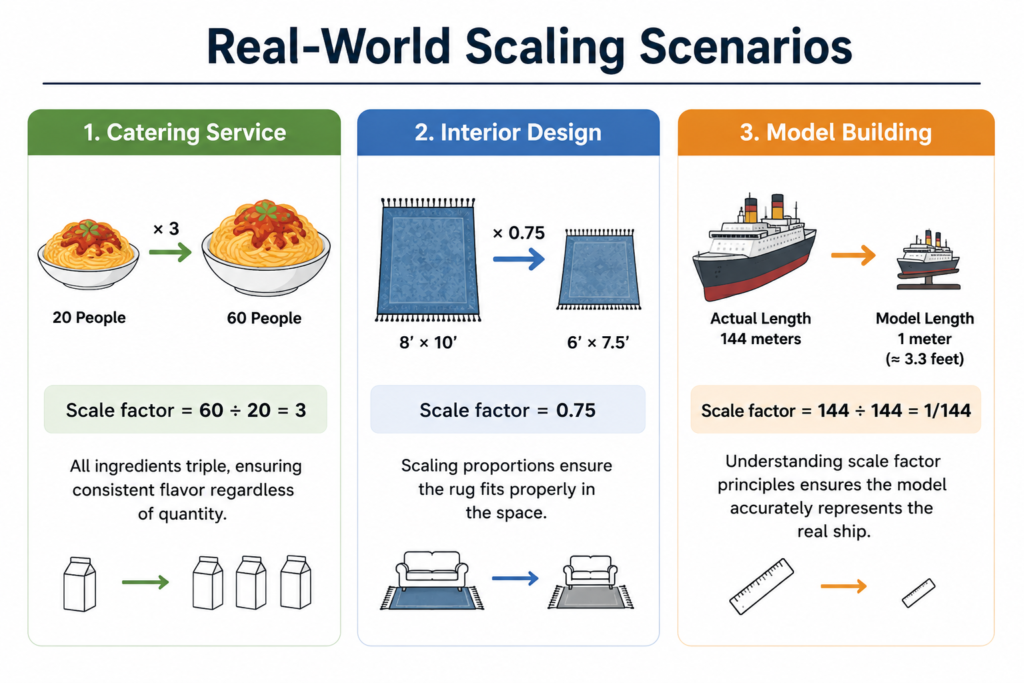
Real-World Scaling Scenarios
Scenario 1: Catering Service
A caterer has a pasta recipe serving 20 people. An event requires 60 servings.
Scale factor = 60 ÷ 20 = 3
All ingredients triple, ensuring consistent flavor regardless of quantity. Recipe scaling requires a scale factor calculator for complex ingredient ratios.
Scenario 2: Interior Design
A designer sees a rug measuring 8′ × 10′ in a showroom. The client’s room is smaller and needs a rug at 75% of original size.
Scale factor = 0.75
New measurements: 6′ × 7.5′
Scaling proportions ensure the rug fits properly in the space.
Scenario 3: Model Building
A hobbyist builds a 1:144 scale model of a ship. The actual ship is 144 meters long.
Model length = 144 meters ÷ 144 = 1 meter (approximately 3.3 feet)
Understanding scale factor calculator principles ensures the model accurately represents the real ship.
Common Scaling Mistakes to Avoid
Mistake 1: Forgetting to Scale All Dimensions
When scaling proportions, all measurements must scale equally. Forgetting one dimension creates distortion.
Mistake 2: Ignoring Non-Linear Ingredients
In recipe scaling, some ingredients (spices, seasonings) don’t scale proportionally. A scale factor calculator helps with measurements but human judgment determines ingredient adjustments.
Mistake 3: Rounding Too Early
In scaling proportions calculations, maintain precision throughout. Round only the final measurement.
Mistake 4: Losing Aspect Ratios
Proportional scaling must maintain aspect ratios. A scale factor calculator prevents this error automatically.
Mistake 5: Misunderstanding Scale Notation
Different scales use different notations. Understanding 1:100 versus 1:50 is crucial for accurate scaling proportions.
Tips for Mastering Scaling Proportions
Tip 1: Understand Scale Factor Calculator Logic
Know that scale factor = desired size ÷ original size. This fundamental understanding simplifies all scaling proportions.
Tip 2: Practice with Real Recipes
Start with simple recipe scaling (doubling or halving). Build confidence before attempting complex ingredient ratios.
Tip 3: Keep Notes on Scaling Adjustments
In recipe scaling, note which ingredients needed adjustments beyond the scale factor. These notes improve future scaling proportions.
Tip 4: Verify Proportions
After scaling, double-check that proportions remain correct. A proportion calculator for scaling simplifies verification.
Tip 5: Use Appropriate Tools
A scale factor calculator or proportion calculator for scaling prevents errors and saves time compared to manual calculations.
Conclusion
Scaling proportions appears everywhere—from recipe cooking to architectural design to artistic creation. Mastering these concepts and utilizing available tools like a scale factor calculator transforms scaling from potentially error-prone work into straightforward, accurate calculations.
Whether scaling proportions for a catering event, using a proportion calculator for scaling architectural plans, or resizing artwork while maintaining aspect ratios, the underlying mathematical principles remain consistent. With understanding of these principles and access to appropriate tools, anyone can scale accurately and confidently across any field or application.