Author: Umar Farooq
Date: August 15, 2026
Category: Mathematics & Proportions
Read Time: 6-7 minutes
Expert Review: Mathematics Education Specialist
Quick Answer: What Is Solving Proportions?
Solving Proportions is a mathematical technique used to solve proportion equations quickly. When you have a proportion like A/B = C/D, cross multiplication means multiplying diagonally: A × D = B × C. This method instantly transforms a proportion into a simpler equation you can solve. Learn cross multiply, and solving proportions becomes straightforward.
What Is Cross Multiplication in Proportions?
Cross multiplication is the foundation of proportion solving. A proportion states that two ratios are equal. When you need to solve a proportion with an unknown value, cross multiplication provides the fastest method.
The principle behind cross multiplication is elegant: if A/B = C/D, then A × D must equal B × C. This relationship allows you to solve proportions without needing a calculator—though our free proportion calculator makes it even faster.
Proportion Solving Formula
The cross multiplication formula is simple but powerful:
For proportion: A/B = C/D
Cross multiply to get: A × D = B × C
This formula works because of the fundamental property of proportions: the product of the means equals the product of the extremes. Understanding this formula makes Proportion Solving intuitive.
How Does Cross Multiplication Work?
Cross multiplication works by rearranging a proportion into an equation with one variable. Here’s the principle:
If two fractions are equal, multiplying the numerator of one by the denominator of the other produces the same result in both directions. This property lets you solve proportions by converting them to simpler linear equations.
Why it works: The proportional relationship guarantees that cross products are equal. This isn’t just a trick—it’s a mathematical law.
How to Solve a Proportion Using Cross Multiplication
Step-by-Step Process
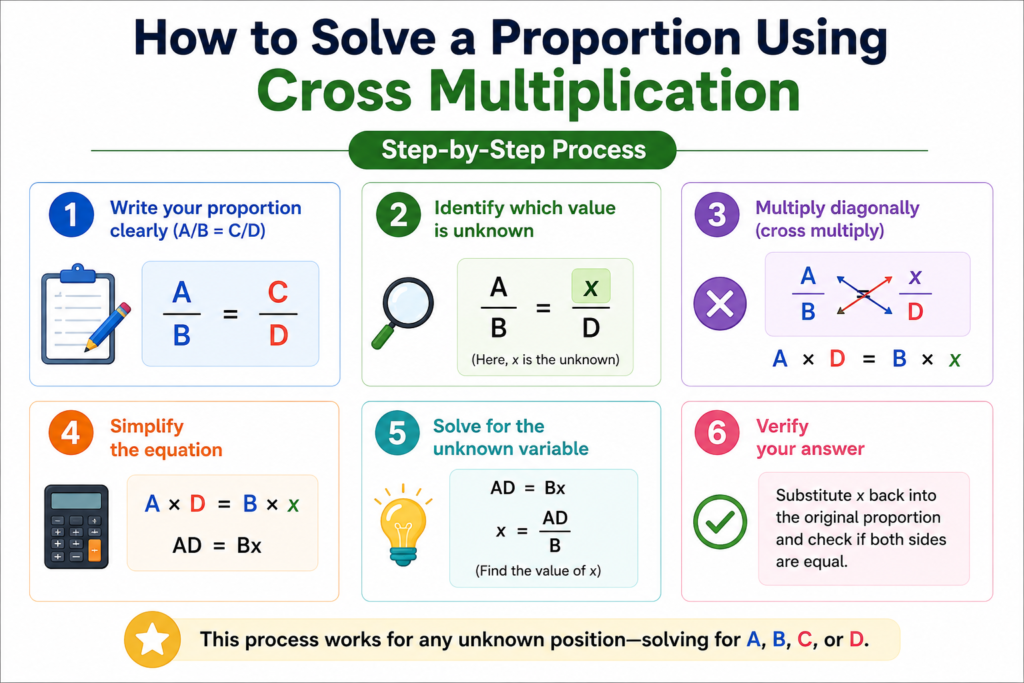
Step 1: Write your proportion clearly (A/B = C/D)
Step 2: Identify which value is unknown
Step 3: Multiply diagonally (cross multiply)
Step 4: Simplify the equation
Step 5: Solve for the unknown variable
Step 6: Verify your answer
This process works for any unknown position—solving for A, B, C, or D.
Step-by-Step Cross Multiplication Example
Problem: 2/5 = x/20. Find x.
| Step | Action | Calculation |
|---|---|---|
| 1 | Write proportion | 2/5 = x/20 |
| 2 | Cross multiply | 2 × 20 = 5 × x |
| 3 | Simplify left side | 40 = 5x |
| 4 | Divide both sides | x = 40 ÷ 5 |
| 5 | Solve | x = 8 |
| 6 | Verify | 2/5 = 8/20? Yes ✓ (both = 0.4) |
This cross multiplication example shows how straightforward the method is. Once you understand this pattern, you can solve any proportion.
Proportion Solving With Fractions and Variables
Proportion Solving handles fractions and variables seamlessly.
With fractions: If 3/4 = 6/x, then 3 × x = 4 × 6, so 3x = 24, giving x = 8.
With variables: If a/3 = 12/9, then a × 9 = 3 × 12, so 9a = 36, giving a = 4.
With decimals: If 0.5/2 = 1.5/x, then 0.5 × x = 2 × 1.5, so 0.5x = 3, giving x = 6.
The Solving Proportions formula works identically regardless of decimal, fraction, or variable format.
How to Check Your Answer
Verification is crucial. Always substitute your answer back into the original proportion to confirm it’s correct.
Verification method:
- Replace the unknown with your answer
- Calculate both sides of the equation
- Check if both sides are equal
- If equal, your answer is correct
Example: If you found x = 8 from 2/5 = x/20, verify: 2/5 = 0.4 and 8/20 = 0.4. ✓ Correct!
Common Cross Multiplication Mistakes
| Mistake | What Happens | How to Avoid |
|---|---|---|
| Multiplying wrong diagonals | Gets wrong answer | Clearly mark which values pair diagonally |
| Sign errors | Calculation wrong | Write each multiplication separately |
| Forgetting to simplify | Leaves answer as fraction | Divide to get final value |
| No verification | Accepts wrong answer | Always substitute back |
| Division errors | Final answer incorrect | Double-check arithmetic |
Avoid these mistakes and cross multiplication becomes your superpower for solving proportions.
Real-World Applications of Proportion Solving
Proportion Solving isn’t just textbook math—it solves real problems daily.
Cooking: Scaling recipes uses Solving Proportions. If 2 cups flour serves 4, then x cups serves 8. Cross multiply: 2 × 8 = 4 × x, so x = 4 cups.
Maps: Converting distances uses cross multiplication. If 1 inch = 50 miles, then 3 inches = x miles. Cross multiply: 1 × x = 50 × 3, so x = 150 miles.
Currency: Exchange rates use cross multiplication. If 1 USD = 85 INR, then 50 USD = x INR. Cross multiply: 1 × x = 85 × 50, so x = 4,250 INR.
Pricing: Bulk pricing uses Proportion Solving. If 4 items cost $80, then 10 items cost $x. Cross multiply to find x instantly.
These real applications show why learning cross multiplication is valuable for practical problem-solving.
Proportion Solving vs Other Methods
| Method | Speed | Accuracy | Difficulty | Best For |
|---|---|---|---|---|
| Cross Multiplication | Fast | 100% | Easy | Most proportions |
| Ratio Tables | Slow | 100% | Medium | Learning concepts |
| Calculator | Instant | 100% | Very Easy | Complex numbers |
| Estimation | Fast | 70% | Easy | Quick approximations |
Cross multiply is your best choice for solving proportions quickly and accurately, especially when doing manual calculations.
Frequently Asked Questions
Q: Why is cross multiplication called “cross”?
A: Because you multiply diagonally across the proportion, forming an X pattern—hence “cross” multiplication.
Q: Can I cross multiply any two fractions?
A: Only if they form a proportion (are equal). Cross multiplication finds if fractions are proportional or solves for unknowns.
Q: Does order matter in Proportion Solving?
A: No. 2 × 9 = 3 × x gives the same answer as 3 × x = 2 × 9. Both equal 18 = 3x, so x = 6.
Q: Is cross multiplication only for proportions?
A: Primarily yes. It’s specifically designed for solving proportions with unknown values.
Q: Can I use cross multiplication manually?
A: Absolutely. It’s perfect for homework and quick calculations. Our calculator just speeds up the process for larger numbers.
Conclusion
Cross multiplication is the essential method for solving proportions. Master this technique, and proportions become simple. Whether you’re learning proportions fundamentally or applying them in real situations, cross multiplication provides the fastest, most reliable solution method.
Practice Proportion Solving regularly, and soon solving proportions becomes automatic. For more detailed guidance, explore our complete guide on solving proportions or use our free proportion calculator to verify your work.
Pingback: Proportion Calculator for Percentages & Discounts: Master Sale Math - Prime Calculator