Introduction
Mathematics often feels abstract until it connects with real life. One of the most practical applications of math is solving word problems using proportions. Whether someone is a student struggling with homework or a professional managing business decisions, knowing how to tackle proportion word problems transforms theoretical knowledge into practical problem-solving ability.
This comprehensive guide explores how proportion word problems appear in everyday situations and how a proportion calculator tool makes solving these problems faster, easier, and more accurate. From cooking measurements to business calculations, real world proportions are everywhere.
What Are Proportion Word Problems?
A proportion word problem presents a scenario describing a relationship between quantities and asks someone to find a missing value. Unlike abstract mathematical equations, word problems tell a story—they describe situations people actually encounter.
For example: “If 4 items cost $32, how much do 10 items cost?” This is a proportion word problem. It describes a real scenario (buying items), provides known information (4 items = $32), and asks for an unknown value (cost of 10 items).
The power of understanding proportion word problems lies in their universality. These problems appear in cooking, construction, medicine, business, travel, and countless other fields.
Why Use a Proportion Calculator Tool for Word Problems?
Solving proportion word problems manually takes time and introduces opportunities for calculation errors. A proportion calculator tool accelerates the process and improves accuracy in several ways.
Speed and Efficiency
Manually solving proportion word problems involves multiple steps: identifying the known values, setting up the proportion, cross multiplying, and solving the equation. A proportion calculator tool accomplishes all of this in seconds. For professionals managing time-sensitive decisions or students with multiple homework problems, this efficiency gain is invaluable.
Accuracy and Error Prevention
Human calculation mistakes are common, especially when working with decimals or fractions. A proportion calculator tool uses precise mathematical algorithms, eliminating computational errors and ensuring every answer is mathematically correct.
Learning Support
Many modern proportion calculator tools show step-by-step solutions alongside final answers. This educational feature helps users understand not just what the answer is, but how it was derived—an essential component of genuine learning.
Accessibility
A proportion calculator tool makes proportion word problems accessible to people of varying mathematical skill levels. Someone uncomfortable with manual calculations can still solve complex real world proportions with confidence.
Common Proportion Word Problem Categories
Cooking and Recipe Problems
These represent the most familiar proportion word problems. Scaling recipes is a daily task for many people.
Example: A brownie recipe serves 6 people using 2 cups of flour. How much flour is needed to serve 15 people?
Setup: 6/2 = 15/x
Using a proportion calculator tool: x = 5 cups of flour
This proportion word problem appears constantly in cooking, and a proportion calculator tool makes recipe scaling effortless.
Distance, Speed, and Time Problems
These real world proportions help travelers and logistics professionals make calculations.
Example: A car travels 180 miles in 3 hours at constant speed. How far will it travel in 5 hours?
Setup: 180/3 = x/5
Using a proportion calculator tool: x = 300 miles
These proportion word problems ensure accurate travel estimates and delivery timeframes.
Business and Pricing Problems
Business professionals frequently encounter proportion word problems involving pricing, discounts, and cost calculations.
Example: If 8 units cost $96, what’s the total cost for 20 units?
Setup: 8/96 = 20/x
Using a proportion calculator tool: x = $240
This type of proportion word problem directly impacts pricing strategies and profit calculations.
Medical and Dosage Problems
Healthcare professionals use real world proportions constantly when calculating medication dosages.
Example: A dosage is 5mg per 10kg of body weight. For a 70kg patient, what’s the correct dosage?
Setup: 5/10 = x/70
Using a proportion calculator tool: x = 35mg
In medical contexts, accuracy in solving proportion word problems is literally life-critical.
Currency and Exchange Problems
Travelers and international business professionals rely on proportion word problems for currency conversion.
Example: 1 USD equals 85 Indian Rupees. How many rupees equal 50 USD?
Setup: 1/85 = 50/x
Using a proportion calculator tool: x = 4,250 INR
These real world proportions help travelers budget and understand international pricing.
Construction and Scaling Problems
Architects and builders use proportion word problems to convert between blueprint measurements and actual dimensions.
Example: On a blueprint, 1 inch represents 5 feet. A room measures 2.5 inches on the blueprint. What’s the actual room size?
Setup: 1/5 = 2.5/x
Using a proportion calculator tool: x = 12.5 feet
These proportion word problems ensure construction projects match design specifications exactly.
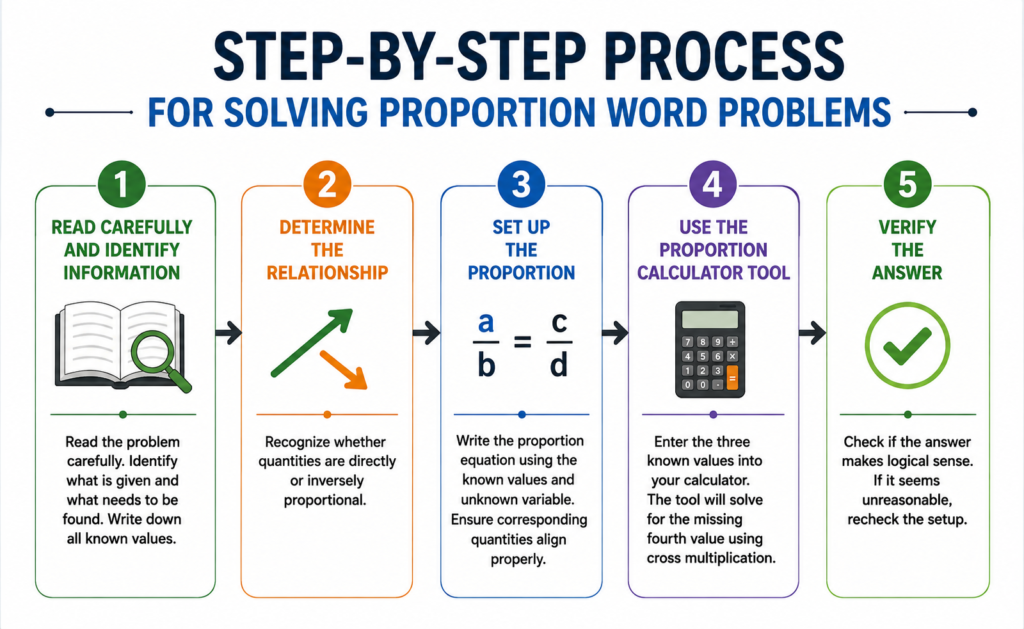
Step-by-Step Process for Solving Proportion Word Problems
Step 1: Read Carefully and Identify Information
First, carefully read the entire problem. Identify what information is given and what needs to be found. Write down all known values.
Step 2: Determine the Relationship
Recognize whether quantities are directly or inversely proportional. Direct proportions increase together (more ingredients = more servings). Inverse proportions move oppositely (more workers = less time needed).
Step 3: Set Up the Proportion
Write the proportion equation using the known values and unknown variable. Ensure corresponding quantities align properly.
Step 4: Use the Proportion Calculator Tool
Enter the three known values into your calculator. A proportion calculator tool will solve for the missing fourth value using cross multiplication.
Step 5: Verify the Answer
Check if the answer makes logical sense. If a recipe problem asks how much flour for double servings, the answer should roughly double. If the answer seems unreasonable, recheck the setup.
Real World Proportions in Different Industries
Food Service Industry
Restaurants constantly scale recipes based on expected customer counts. Head chefs use proportion word problems daily to adjust ingredient quantities while maintaining flavor profiles and ratios. A proportion calculator tool helps maintain consistency across all servings.
Construction and Architecture
Architects work with scaled drawings where every measurement represents a larger real-world dimension. Solving proportion word problems accurately ensures buildings match designs. A proportion calculator tool prevents costly measurement errors.
Healthcare and Pharmacy
Medical professionals calculate medication dosages using proportion word problems. Getting these calculations wrong has serious consequences. A proportion calculator tool provides reliable accuracy for medical calculations.
Retail and E-Commerce
Retailers solve proportion word problems when calculating bulk pricing, determining profit margins, and managing inventory proportionally. Business owners use real world proportions to make pricing decisions affecting profitability.
Travel and Tourism
Tour operators use proportion word problems to calculate travel distances, fuel consumption, and accommodation needs. Travel planning heavily relies on proportion word problems for accurate itineraries.
Manufacturing and Production
Manufacturers use real world proportions to scale production batches, maintain quality ratios, and calculate material requirements. Consistent proportional relationships ensure product quality across different production volumes.
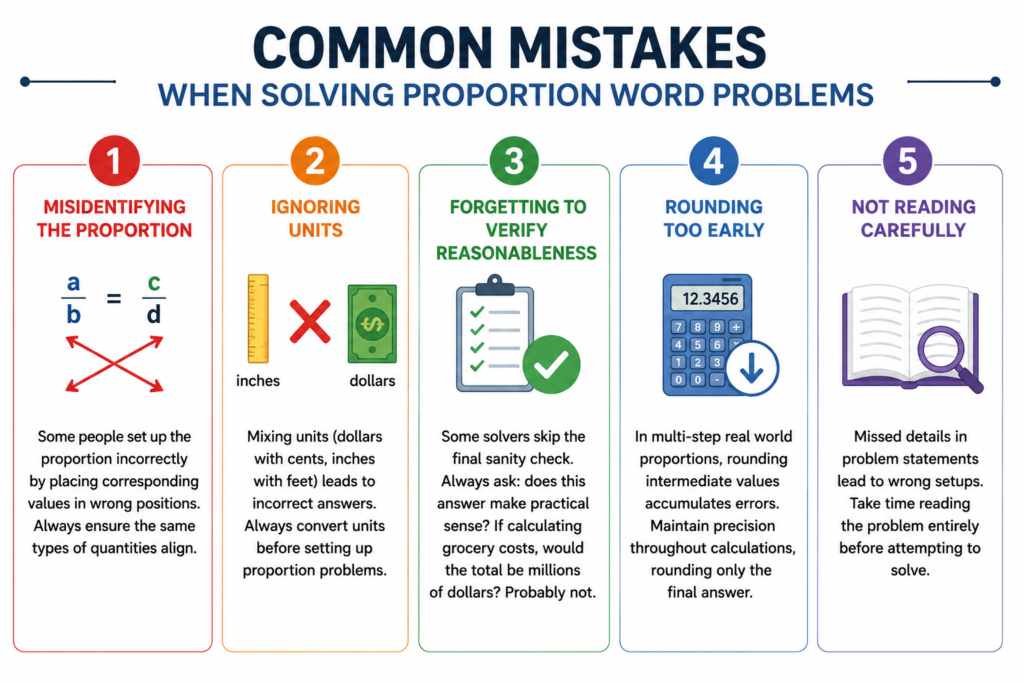
Common Mistakes When Solving Proportion Word Problems
Mistake 1: Misidentifying the Proportion
Some people set up the proportion incorrectly by placing corresponding values in wrong positions. Always ensure the same types of quantities align (numerators represent same items as other numerators).
Mistake 2: Ignoring Units
Mixing units (dollars with cents, inches with feet) leads to incorrect answers. Always convert units before setting up proportion word problems.
Mistake 3: Forgetting to Verify Reasonableness
Some solvers skip the final sanity check. Always ask: does this answer make practical sense? If calculating grocery costs, would the total be millions of dollars? Probably not.
Mistake 4: Rounding Too Early
In multi-step real world proportions, rounding intermediate values accumulates errors. Maintain precision throughout calculations, rounding only the final answer.
Mistake 5: Not Reading Carefully
Missed details in problem statements lead to wrong setups. Take time reading the problem entirely before attempting to solve proportion word problems.
Advantages of Modern Proportion Calculator Tools
Today’s proportion calculator tools offer features beyond basic calculation:
Instant Results: Solve proportion word problems in seconds, not minutes.
Detailed Solutions: See step-by-step working showing exactly how answers were derived.
Multiple Formats: Accept different input formats (fractions, decimals, percentages) for various proportion word problems.
Mobile Accessibility: Solve real world proportions on phones, tablets, or computers anywhere, anytime.
No Cost: Free tools eliminate barriers to accurate calculations.
Educational Value: Step-by-step displays help users learn proportional reasoning alongside getting answers.
Tips for Mastering Proportion Word Problems
Practice with Real Scenarios
Use actual cooking, shopping, or travel scenarios when practicing. Real world proportions feel more concrete than abstract examples.
Use a Proportion Calculator Tool Strategically
Use the calculator to verify manual work initially. Gradually build confidence, eventually relying on the tool only for complex calculations.
Teach Someone Else
Explaining how to solve proportion word problems to another person reveals gaps in understanding and solidifies knowledge.
Connect to Prior Knowledge
Relate new proportion word problems to similar ones already solved. Pattern recognition strengthens problem-solving abilities.
Vary Problem Types
Practice with different category types—recipes, distances, money, measurements. Diverse practice develops flexible thinking.
Conclusion
Proportion word problems are far from abstract mathematical exercises. They represent real-world situations everyone encounters. Knowing how to solve them efficiently—whether through manual calculation or using a proportion calculator tool—empowers better decision-making in cooking, business, healthcare, travel, and countless other fields.
A proportion calculator tool democratizes the ability to solve real world proportions quickly and accurately. Rather than replacing mathematical understanding, these tools support learning while providing practical assistance for everyday problem-solving. By mastering the conceptual foundation and leveraging available tools, anyone can confidently tackle proportion word problems and apply proportional reasoning to improve daily decisions.
Pingback: Scaling Proportions: 7 Powerful Tips & Scale Factor Guide - Prime Calculator