Author: Umar Farooq
Date: August 15, 2026
Category: Business & Finance
Read Time: 8-9 minutes
Expert Review: Business Finance & Accounting Specialist
Quick Answer: How Do Proportions Work in Business Pricing?
A business proportion calculator uses mathematical proportions to solve pricing, cost, and financial problems instantly. When you know the cost per unit and need total cost for a quantity, a business proportion calculator sets up: unit cost : quantity = total cost : x. For example, if one item costs $5 and you need 50 items, the calculator solves: $5 / 1 = x / 50, giving $250 total. Business proportion calculator applications span retail pricing, wholesale calculations, markup analysis, discounts, and commission structures.
What Is a Business Proportion Calculator?
A business proportion calculator is a specialized tool for financial decision-making. It solves proportion equations related to pricing, costs, markups, discounts, and margins. Every business transaction involves proportional relationships—whether calculating bulk pricing, applying discounts, or determining commissions.
Traditional spreadsheets handle these calculations, but a business proportion calculator provides instant solutions with built-in verification. This eliminates errors in critical financial calculations. Understanding how to use a business proportion calculator transforms business math from manual labor into automated precision. Learn more about how to solve proportions to deepen your understanding of the underlying mathematics.
How Proportions Work in Business Calculations
Business transactions are fundamentally proportional. When you scale quantities, costs scale proportionally. When you apply percentages, proportions determine the result. A business proportion calculator automates these relationships.
Core Business Proportion Structure: Cost / Quantity = Total Cost / New Quantity
Every business pricing model uses this foundation. Understanding proportion principles provides insight into why professional proportion calculators are essential business tools.
Business Proportion Calculator Formulas
| Calculation | Formula | Example |
|---|---|---|
| Unit Cost | Total Cost ÷ Quantity | $500 ÷ 100 units = $5/unit |
| Total Cost | Unit Cost × Quantity | $5 × 200 units = $1,000 |
| Bulk Discount | Unit Cost × Discount % | $5 × 10% = $0.50 savings |
| Markup Amount | Cost × Markup % | $100 cost × 20% = $20 markup |
| Selling Price | Cost + Markup Amount | $100 + $20 = $120 |
| Profit Margin % | (Profit ÷ Selling Price) × 100 | ($20 ÷ $120) × 100 = 16.67% |
| Discount Amount | Original Price × Discount % | $120 × 10% = $12 off |
| Sale Price | Original Price − Discount | $120 − $12 = $108 |
| Commission | Sales Amount × Commission % | $5,000 × 5% = $250 |
A business proportion calculator handles all these formulas automatically. Understanding each relationship shows why proportions are fundamental to commerce.
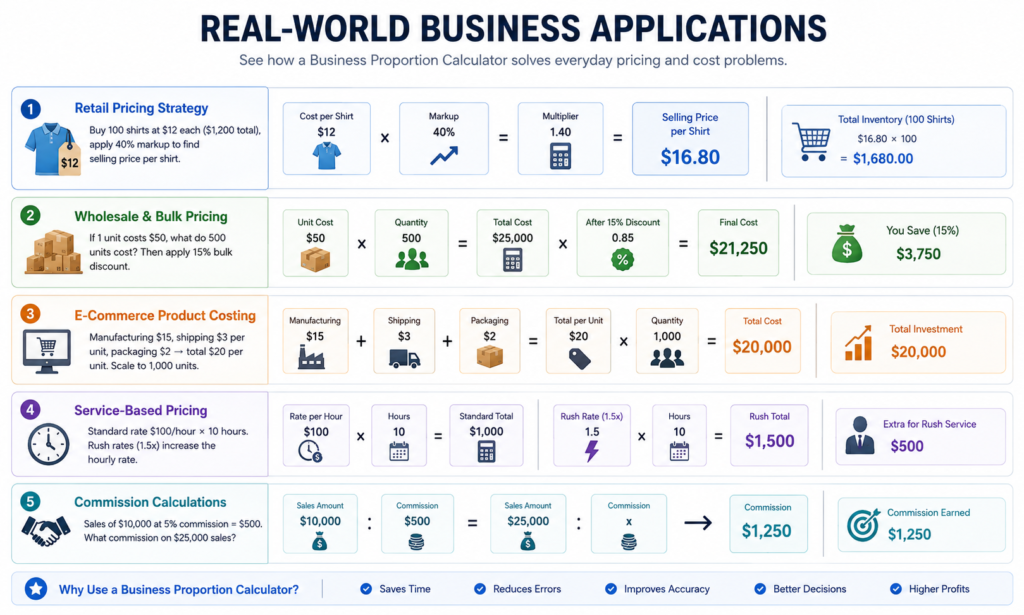
Real-World Business Applications
Retail Pricing Strategy
Retailers use business proportion calculator methods to determine selling prices. Buy 100 shirts at $12 each ($1,200 total), apply 40% markup: selling price = $12 × 1.40 = $16.80 per shirt. A business proportion calculator scales this across entire inventory automatically. For percentage-based calculations, our discount and percentage calculator handles complex retail scenarios.
Wholesale & Bulk Pricing
Wholesalers negotiate volume discounts using proportions. If 1 unit costs $50, what do 500 units cost? A business proportion calculator solves: $50 / 1 = x / 500, giving $25,000. Add bulk discount (15%): $25,000 × 0.85 = $21,250. Wholesalers rely on scaling proportions for every quote.
E-Commerce Product Costing
Online sellers calculate product costs with multiple components—manufacturing, shipping, packaging. A business proportion calculator combines these proportionally. Manufacturing cost $15, shipping $3 per unit, packaging $2 → total $20. Scaling to 1,000 units: $20 × 1,000 = $20,000. This is proportion word problem solving applied to business.
Service-Based Pricing
Service businesses use hourly rates scaled by hours worked. Standard rate $100/hour × 10 hours = $1,000. Rush rates (1.5x): $100 × 1.5 = $150/hour × 10 = $1,500. A business proportion calculator maintains these relationships perfectly.
Commission Calculations
Sales commissions use proportions universally. Sales of $10,000 at 5% commission = $500. A business proportion calculator scales this: if $10,000 generates $500 commission, what does $25,000 generate? Proportion: $10,000 / $500 = $25,000 / x → x = $1,250.
Markup vs Profit Margin: Critical Distinction
| Aspect | Markup | Profit Margin |
|---|---|---|
| Definition | Percentage added to cost | Percentage of selling price that’s profit |
| Based On | Cost price | Selling price |
| Formula | (Selling Price − Cost) ÷ Cost × 100 | (Profit ÷ Selling Price) × 100 |
| Example | $100 cost + 20% markup = $120 selling | $100 profit ÷ $600 selling = 16.67% margin |
| Purpose | Sets pricing strategy | Measures business profitability |
| Relationship | Higher markup ≠ higher margin | Depends on costs and market price |
A business proportion calculator clarifies this distinction. 20% markup means “add 20% to cost.” 20% profit margin means “20% of revenue is profit.” These are fundamentally different calculations, and using the wrong one leads to serious pricing errors.
Business Calculations: Step-by-Step Example
Retail Pricing Scenario
Situation: Buy 200 shirts at $12 wholesale. Apply 50% markup. Calculate selling price and profit.
Step 1: Calculate total wholesale cost
- Unit cost: $12
- Quantity: 200
- Total cost: $12 × 200 = $2,400
Step 2: Calculate markup amount
- Markup percentage: 50%
- Markup amount: $12 × 50% = $6
- Selling price per shirt: $12 + $6 = $18
Step 3: Calculate total revenue at selling price
- Selling price per unit: $18
- Quantity: 200
- Total revenue: $18 × 200 = $3,600
Step 4: Calculate profit
- Total revenue: $3,600
- Total cost: $2,400
- Profit: $3,600 − $2,400 = $1,200
Step 5: Calculate profit margin percentage
- Profit margin: ($1,200 ÷ $3,600) × 100 = 33.33%
A business proportion calculator automates every step, preventing mathematical errors in critical business decisions.
Common Business Proportion Mistakes
| Mistake | Impact | Prevention |
|---|---|---|
| Confusing markup & margin | Wrong pricing strategy | Know the distinction; verify formulas |
| Wrong quantity units | Cost miscalculation | Double-check units (per unit vs. total) |
| Ignoring fixed costs | Oversimplified pricing | Separate fixed and variable costs |
| Forgetting discount stacking | Revenue loss | Calculate discounts sequentially |
| Mixing currencies | Invalid comparison | Keep currency consistent throughout |
| Rounding early | Accumulated errors | Round only the final result |
| Not verifying proportions | Silent errors | Check proportions match original ratios |
A business proportion calculator prevents most errors through systematic calculation and verification.
Comparing Business Methods
| Method | Speed | Accuracy | Best For |
|---|---|---|---|
| Business Proportion Calculator | Instant | 100% | Quick decisions, verification |
| Manual Calculation | Slow | Error-prone | Learning, small quantities |
| Spreadsheet | Fast | Depends on formula | Bulk calculations, complex models |
| Accounting Software | Instant | 100% | Complete business operations |
For isolated proportion-based business calculations, a business proportion calculator provides the perfect balance of speed and accuracy.
Frequently Asked Questions
Q: How do you use proportions in business pricing?
A: Set up the proportion with known values (cost, quantity) and solve for unknown (total cost, selling price). Learn more with our free proportion calculator.
Q: What’s the difference between markup and profit margin?
A: Markup is percentage of cost; profit margin is percentage of selling price. This distinction is critical for correct business calculations.
Q: Can proportions calculate commission from sales?
A: Yes! Commission is directly proportional to sales. If 5% commission on $10,000 = $500, then on $20,000 = $1,000. This is basic proportion math.
Q: How do bulk discounts work with proportions? A: Bulk pricing creates proportional relationships. More quantity = lower per-unit cost. A business proportion calculator scales these instantly. See our scaling guide.
Q: Should I use a calculator or spreadsheet for business math?
A: For single calculations, a business proportion calculator is faster. For ongoing business operations, spreadsheets or accounting software are better.
Q: Can proportions handle discounts and markups together?
A: Yes! Apply markup first (cost → selling price), then calculate discounts (selling price → sale price). A business proportion calculator handles both sequential steps.
Q: How do I verify a business calculation is correct?
A: Check that proportions match original ratios. If $12 : 1 = x : 50, then verify x ÷ 50 = 12 ÷ 1. Proportions must balance perfectly.
Q: Are business proportions different from other proportions?
A: No. Business proportions follow identical mathematical rules as ratios and proportions. Context differs, but mathematics is universal.
Real-World Business Scenarios
Scenario 1: Retail Inventory
You buy 500 units at $8 each. Apply 45% markup for selling price. Calculate profit per unit and total profit on 400 sales.
Calculation: Selling price = $8 × 1.45 = $11.60. Profit per unit = $3.60. Total profit = $3.60 × 400 = $1,440.
Scenario 2: Service Commission
Your sales team generates $150,000 in monthly sales. Commission is 3% of sales. Calculate total commission payout.
Calculation: $150,000 × 0.03 = $4,500 commission.
Scenario 3: International Wholesale
You import products at £20/unit (UK pricing). Exchange rate: £1 = $1.27. Calculate USD cost per unit and total for 1,000 units.
Calculation: £20 × $1.27 = $25.40 USD per unit. Total = $25,400 for 1,000 units. For exchange calculations, explore unit conversion proportions.
Conclusion
Business proportion calculator applications extend across every commercial function—retail pricing, wholesale negotiations, commission structures, and financial analysis. Mastering proportion-based business calculations separates successful businesses from those struggling with pricing errors.
Whether you’re a retail manager setting prices, a wholesale buyer negotiating volume discounts, an e-commerce seller calculating product costs, or a service provider structuring commission plans, a business proportion calculator ensures accuracy and efficiency. Combine this with understanding complete proportion concepts, and you’ll make confident financial decisions backed by solid mathematics.
For immediate business calculations, use our free business proportion calculator. For deeper learning, explore our proportion solving method and practical business examples.