Introduction
Mathematics can feel overwhelming, especially when dealing with ratios and proportional relationships. Whether someone is a student tackling homework, a professional working on project scaling, or someone simply curious about how to balance equations, there’s a powerful tool that makes everything easier: the Proportion Calculator.
This comprehensive guide explores everything one needs to know about proportion calculators, how they work, and why they’re indispensable in both academic and real-world scenarios. From basic concepts to advanced applications, readers will discover how a Proportion Calculator simplifies complex mathematical problems and saves valuable time.
What Is a Proportion Calculator?
A Proportion Calculator is a digital tool designed to solve proportional problems quickly and accurately. At its core, a Proportion Calculator works by taking numerical values and applying mathematical principles to find missing amounts in proportional relationships.
In mathematical terms, a proportion is an equation stating that two ratios are equal. For example, if 2 apples cost $3, then 4 apples would cost $6. This relationship is proportional, and solving such problems manually can be tedious. This is where a Proportion Calculator becomes invaluable.
Key Features of an Effective Proportion Calculator
- Fast computation: Instant results without manual calculations
- Accuracy: Eliminates human calculation errors
- User-friendly interface: Simple input fields for easy data entry
- Multiple format support: Handles different ratio types and expressions
- Real-time feedback: Shows results immediately as users input values
Understanding the Mathematical Foundation
Before using a Proportion Calculator, it helps to understand the math behind it. Proportions rely on the concept of ratios, which compare two quantities.
The Basics of Ratios
A ratio expresses the relationship between two numbers. For instance, if a recipe calls for 2 cups of flour to 1 cup of sugar, the ratio is 2:1. Understanding ratios is fundamental to grasping how a Proportion Calculator operates.
What Makes Something Proportional?
Two quantities are proportional when they maintain a constant ratio. If the ratio between variable A and variable B remains consistent, they are in proportion. This is the principle that drives every calculation in a Proportion Calculator.
Cross Multiplication: The Core Method
The primary mathematical method used in a Proportion Calculator is cross multiplication. When solving the proportion a/b = c/d, cross multiplication multiplies the first term by the fourth term and the second term by the third term. This method is reliable, efficient, and forms the backbone of proportion solving.
How to Use a Proportion Calculator
Step-by-Step Process
Step 1: Identify the Known Values
First, determine which numbers are known and which need to be found. In the proportion a/b = c/d, if a person knows three values, they can use a Proportion Calculator to find the fourth.
Step 2: Input the Values
Enter the known values into the appropriate fields in the calculator. Most digital proportion solvers have labeled input boxes making this process straightforward.
Step 3: Select the Unknown Variable
Identify which value is missing and ensure the calculator knows what to solve for. Some modern tools automatically detect this.
Step 4: Execute the Calculation
Click the solve button and let the tool work. A reliable Proportion Calculator will instantly provide the answer.
Step 5: Verify the Result
Double-check the answer by multiplying to ensure both ratios are equal. This verification step confirms the accuracy of the proportional relationship.
Common Input Formats
Different scenarios require different input approaches. A Proportion Calculator might handle:
- Ratio format: 2:3 = x:9
- Fraction format: 2/3 = x/9
- Percentage format: 20% of 50 = x% of 100
- Word problem format: “If 5 items cost $20, how much do 8 items cost?”
Real-World Applications of Proportion Calculators
Cooking and Recipe Scaling
One of the most practical everyday uses of a Proportion Calculator is adjusting recipes. If a recipe serves 4 people but someone needs to feed 10, they need to scale ingredients proportionally. A Proportion Calculator makes this effortless, ensuring the dish maintains its intended flavor and texture.
Construction and Architecture
In construction, architects and builders frequently work with scaled drawings. A Proportion Calculator helps translate blueprint measurements to actual building dimensions, ensuring projects are built to specifications.
Business and Finance
Financial professionals use proportion calculators for markup calculations, profit margins, and cost analysis. Understanding proportional relationships helps businesses make informed pricing decisions and optimize financial operations.
Medicine and Pharmacy
Healthcare professionals rely on proportional calculations when determining medication dosages based on patient weight or age. Accuracy in these calculations is literally life-saving.
Art and Design
Artists use proportional relationships to maintain aesthetic balance. Whether resizing artwork or maintaining aspect ratios in digital design, a Proportion Calculator ensures visual harmony.
Education and Academics
Students across various subjects use these tools for chemistry stoichiometry, physics problems, geography scale conversions, and countless other academic pursuits.
Solving Proportions: Practical Examples
Example 1: Basic Ratio Problem
Scenario: If 3 notebooks cost $12, how much do 7 notebooks cost?
Setup: 3/12 = 7/x
Solution: Using cross multiplication: 3x = 12 × 7 = 84, therefore x = 28
So 7 notebooks cost $28.
Example 2: Scaling a Recipe
Scenario: A brownie recipe serves 8 people and calls for 2 cups of flour. How much flour is needed to serve 12 people?
Setup: 8/2 = 12/x
Solution: 8x = 2 × 12 = 24, therefore x = 3
One would need 3 cups of flour to serve 12 people.
Example 3: Distance and Speed
Scenario: A car travels 120 miles in 2 hours. At the same rate, how far will it travel in 5 hours?
Setup: 120/2 = x/5
Solution: 2x = 120 × 5 = 600, therefore x = 300
The car will travel 300 miles in 5 hours.
Example 4: Map Scale Conversion
Scenario: On a map, 1 inch represents 50 miles. If two cities are 3 inches apart on the map, what’s the actual distance?
Setup: 1/50 = 3/x
Solution: x = 50 × 3 = 150
The actual distance between the cities is 150 miles.
Types of Proportional Problems
Direct Proportions
In direct proportions, as one quantity increases, the other increases at the same rate. Examples include buying more items at a constant price per unit or traveling faster over longer distances.
Inverse Proportions
In inverse proportions, as one quantity increases, the other decreases proportionally. For example, more workers complete a job faster; increasing the number of workers inversely affects the time needed.
Compound Proportions
Compound proportions involve more than two quantities. A worker might calculate how time, workers, and task complexity all relate proportionally to project completion.
Why Use a Proportion Calculator Over Manual Methods?
Speed and Efficiency
Manual calculations take time. A Proportion Calculator delivers instant answers, which is crucial in time-sensitive situations.
Accuracy and Error Prevention
Human error is common in mathematics. A properly programmed Proportion Calculator eliminates computational mistakes, ensuring reliable results.
Accessibility
Not everyone feels confident with mental math or long division. A Proportion Calculator democratizes mathematical problem-solving, making it accessible to people of varying mathematical abilities.
Verification Tool
Even those skilled in mathematics use a Proportion Calculator to verify manual calculations. It serves as a reliable double-check mechanism.
Educational Value
Contrary to common misconception, using a Proportion Calculator doesn’t hinder learning. Students can verify their work, understand concepts better, and focus on problem-solving strategy rather than computational mechanics.
Advanced Features in Modern Proportion Calculators
Multiple Ratio Support
Advanced tools handle problems with multiple ratios simultaneously, useful for complex scaling problems.
Step-by-Step Solutions
Many calculators now show the working steps, helping users understand not just the answer but the process.
Unit Conversion Integration
Some proportion solvers include built-in unit conversion, handling problems that span different measurement systems.
Mobile Compatibility
Modern calculators work seamlessly across devices, offering accessibility whether someone uses a desktop, tablet, or smartphone.
Custom Variables
Advanced versions allow users to define their own variables and solve for any unknown in the proportion.
Common Mistakes When Working With Proportions
Mixing Up the Order
Placing values in the wrong position is a frequent error. Users must ensure corresponding values align correctly in the proportion setup.
Forgetting to Simplify
Sometimes proportions can be simplified before solving, making calculations easier.
Ignoring Units
Failing to keep units consistent can lead to incorrect answers. Apples must be compared with apples, not oranges.
Rounding Prematurely
Rounding intermediate steps can accumulate errors. It’s better to maintain full precision until the final answer.
Misidentifying Proportional Relationships
Not all relationships are proportional. Assuming proportionality where it doesn’t exist leads to incorrect applications of proportion calculators.
Tips for Choosing the Right Proportion Calculator
Evaluate User Interface
The best tool is one that’s intuitive. A cluttered interface creates confusion regardless of computational power.
Check Accuracy
Verify the calculator against known solutions. Reliable tools consistently produce correct results.
Look for Transparency
Tools that show their work build confidence in the results and aid in understanding.
Consider Features
Assess whether the tool offers all needed functionality, from basic ratio solving to advanced features.
Verify Mobile Support
In today’s world, mobile compatibility is essential for accessibility.
Proportion Calculators in Different Disciplines
Chemistry and Stoichiometry
Chemists use proportion calculations to balance equations and predict reaction quantities. Stoichiometry, the study of quantitative relationships in chemistry, relies heavily on proportional reasoning.
Physics and Engineering
Engineers apply proportions when scaling designs, calculating forces, and solving complex mechanical problems.
Economics and Statistics
Economists use proportions to analyze market trends, calculate inflation rates, and project economic growth.
Geography and Cartography
Cartographers use proportional scaling to create accurate maps, converting large real-world areas into manageable map representations.
Nutrition and Dietary Planning
Nutritionists calculate proportional macronutrient ratios and scale meal plans using proportional relationships.
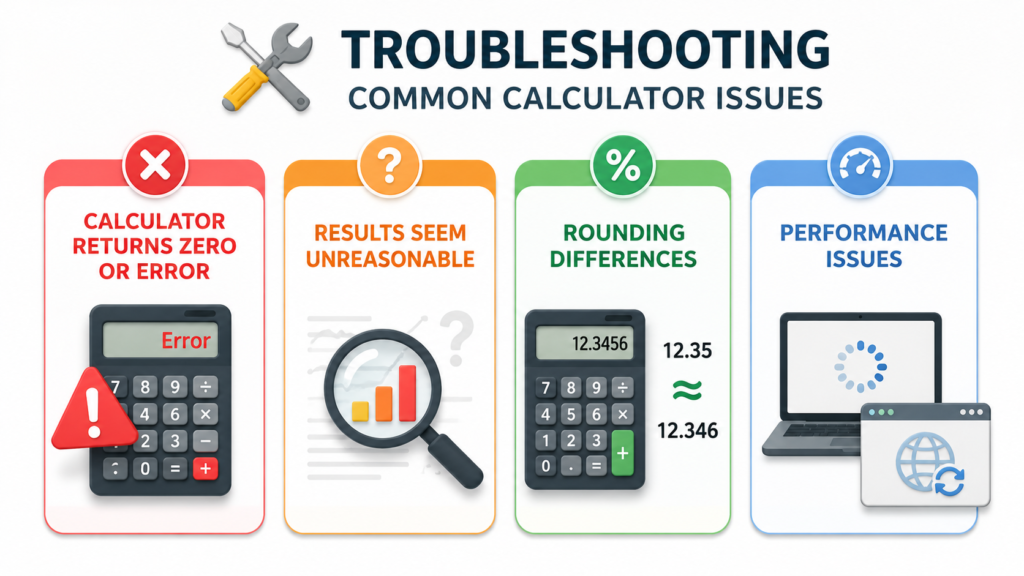
Troubleshooting Common Calculator Issues
Calculator Returns Zero or Error
Usually indicates an input error or division by zero. Check that all values are entered correctly and non-zero where required.
Results Seem Unreasonable
Verify inputs and ensure the proportional relationship actually exists. Sometimes the relationship isn’t truly proportional.
Rounding Differences
Different tools may handle decimal precision differently. Slight variations are often due to rounding protocols.
Performance Issues
On older devices or browsers, calculators might slow down. Try refreshing or using a different browser.
Future of Proportion Calculators
AI-Powered Problem Solving
Artificial intelligence is beginning to enhance calculators by interpreting word problems and automatically setting up proportions.
Augmented Reality Applications
AR technology may allow users to solve proportions by photographing real-world objects and instantly calculating relationships.
Integration with Learning Platforms
Proportion calculators are increasingly embedded in comprehensive math learning platforms offering contextual help and tutorials.
Personalized Learning Pathways
Future tools may adapt to individual learning styles, providing customized explanations and difficulty levels.
Conclusion
A Proportion Calculator is more than just a convenience tool—it’s a bridge connecting mathematical concepts to practical applications. Whether for academic success, professional efficiency, or everyday problem-solving, understanding how to effectively use these tools enhances one’s ability to navigate a numerically-driven world.
From students struggling with homework to professionals managing complex projects, proportion calculators serve a vital function in modern mathematics. By mastering the concepts behind proportional relationships and leveraging technology efficiently, anyone can solve mathematical problems with confidence and accuracy.
The key is not to view calculators as replacements for mathematical understanding but as partners in learning and problem-solving. With this comprehensive guide, readers are now equipped to use proportion calculators effectively and understand the powerful mathematics driving them.
Pingback: Proportion Word Problems: Solve Real-World Math Fast - Prime Calculator