Author: Umar Farooq
Date: August 15, 2026
Category: Geography & Travel
Read Time: 6-7 minutes
Expert Review: Geography & Navigation Specialist
How Do You Calculate Distance Using Map Scales?
A map scale proportion calculator converts map measurements into real-world distances. When a map shows “1 inch = 50 miles,” you’re looking at a proportion. To find actual distance, set up the equation: map distance / map scale = actual distance / real scale. A map scale calculator instantly solves these proportion problems, letting you determine real distances from any map measurement.
What Is a Map Scale Proportion Calculator?
A map scale proportion calculator is a tool designed specifically for geographic distance calculations. Maps represent real-world areas at reduced sizes using scales. A map scale calculator helps you convert those scaled measurements into actual distances.
Every map includes a scale—usually shown as “1 inch = 50 miles” or “1 cm = 10 km.” This scale IS a proportion. Using a map scale proportion calculator, you can measure any distance on the map and instantly know the real-world equivalent. This transforms maps from abstract representations into practical travel planning tools.
How Map Scales Work as Proportions
Map scales are fundamentally proportions. The scale represents the ratio between map distance and real distance.
Basic Principle: Map Distance / Real Distance = Scale Factor
When a map shows “1 inch = 50 miles,” you’re seeing a proportion: 1 in : 50 mi. Any measurement on the map can be converted using this proportion.
Example: If you measure 3 inches on the map, you calculate: 1 in / 50 mi = 3 in / x mi. Solving gives x = 150 miles. A map scale calculator automates this entire process. Understanding how to solve proportions makes map reading intuitive.
Common Map Scales and Their Uses
| Map Type | Typical Scale | Use Case | Example |
|---|---|---|---|
| World Maps | 1 inch = 1,000 miles | Continental overview | Comparing countries |
| Regional Maps | 1 inch = 100 miles | State/province planning | Road trips |
| City Maps | 1 inch = 1 mile | Urban navigation | Walking tours |
| Hiking Maps | 1 cm = 1 km | Trail planning | Outdoor adventures |
| Property Plans | 1 inch = 50 feet | Real estate | Land surveys |
A map scale proportion calculator works identically for all these scales. The principle remains constant—proportion-based conversion.
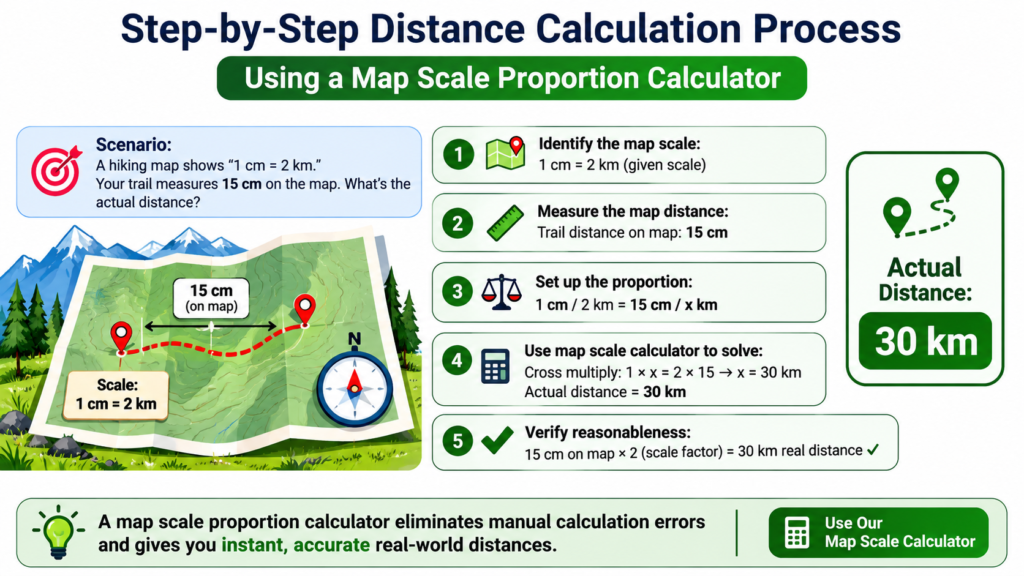
Step-by-Step Distance Calculation Process
Using a Map Scale Proportion Calculator
Scenario: A hiking map shows “1 cm = 2 km.” Your trail measures 15 cm on the map. What’s the actual distance?
Step 1: Identify the map scale
- 1 cm = 2 km (given scale)
Step 2: Measure the map distance
- Trail distance on map: 15 cm
Step 3: Set up the proportion
- 1 cm / 2 km = 15 cm / x km
Step 4: Use map scale calculator to solve
- Cross multiply: 1 × x = 2 × 15
- x = 30 km actual distance
Step 5: Verify reasonableness
- 15 cm on map × 2 (scale factor) = 30 km real distance ✓
A map scale proportion calculator eliminates manual calculation errors.
Real-World Map Scale Applications
Travel Planning
Using a map scale calculator for road trips. Measure the distance on your map, apply the scale, and know exactly how far you’re traveling. Plan driving time accurately.
Hiking and Outdoor Adventures
Hikers rely on map scale calculators to estimate trail distances. A 10 cm measurement on a 1:50,000 scale map equals 5 km of actual hiking—crucial for planning supplies and time.
Geography Education
Students use map scale calculators to understand real distances behind map representations. This builds geographic literacy and spatial reasoning.
Urban Planning
City planners and architects use map scale calculations for development projects. Our proportion calculator helps convert architectural plans into construction specifications.
Aviation and Navigation
Pilots use map scales to calculate flight distances. A map scale calculator provides quick distance verification for flight planning.
Map Scale Reference Tables
Converting Common Scales
| Scale Ratio | 1 inch Equals | 1 cm Equals |
|---|---|---|
| 1:24,000 | 0.38 miles | 240 meters |
| 1:50,000 | 0.79 miles | 500 meters |
| 1:100,000 | 1.58 miles | 1 km |
| 1:250,000 | 3.95 miles | 2.5 km |
| 1:1,000,000 | 15.8 miles | 10 km |
Using a map scale proportion calculator, these reference values become tools for instant distance conversion. Measure on any map, apply the scale, get real distances.
Common Map Reading Mistakes
| Mistake | Problem | Solution |
|---|---|---|
| Wrong scale used | Calculation way off | Double-check map scale carefully |
| Unit mismatch | Mixing inches/centimeters | Convert units consistently first |
| Inverted scale | Backward calculation | Remember: map distance first, real distance second |
| Rounding early | Accumulated errors | Round only the final answer |
| Forgetting units | Unclear distance | Always label your answer with units |
A map scale proportion calculator prevents most errors by handling unit conversion automatically.
Frequently Asked Questions
Q: Why use proportions for map scales? A: Proportions represent the mathematical relationship between map and reality. Learn more about proportion concepts to understand why this works universally.
Q: Can I use a map scale calculator with any map? A: Yes, if the map includes a scale. All maps contain scales—sometimes marked clearly, sometimes shown as a graphic scale bar.
Q: How do I estimate scale if the map doesn’t show it? A: You can estimate if you know the actual distance between two points on the map. Use that to calculate the implied scale, then apply it to other measurements.
Q: Does this work for digital maps? A: Absolutely. Digital maps (Google Maps, etc.) show zoom levels. You can measure distances digitally, then convert using the same proportion method.
Q: What if I’m measuring curved roads? A: Use a flexible ruler or string to trace the route, then measure. The proportion calculation remains identical—the scale factor applies to all measured distances.
Q: Can proportions convert between map scale units? A: Yes! Convert the scale itself first, then apply it. Our proportion calculator handles all unit conversions seamlessly.
Conclusion
Map scales are proportions—mathematical relationships between representation and reality. Understanding this makes map reading intuitive and practical. Whether planning a cross-country road trip or estimating hiking trail distances, a map scale proportion calculator provides accurate conversions instantly.
Learn more about scaling and proportions for deeper understanding. For quick distance calculations, use our free proportion calculator designed specifically for geographic measurements and real-world distance planning.
Pingback: Direct Proportion vs Inverse Proportion - Prime Calculator